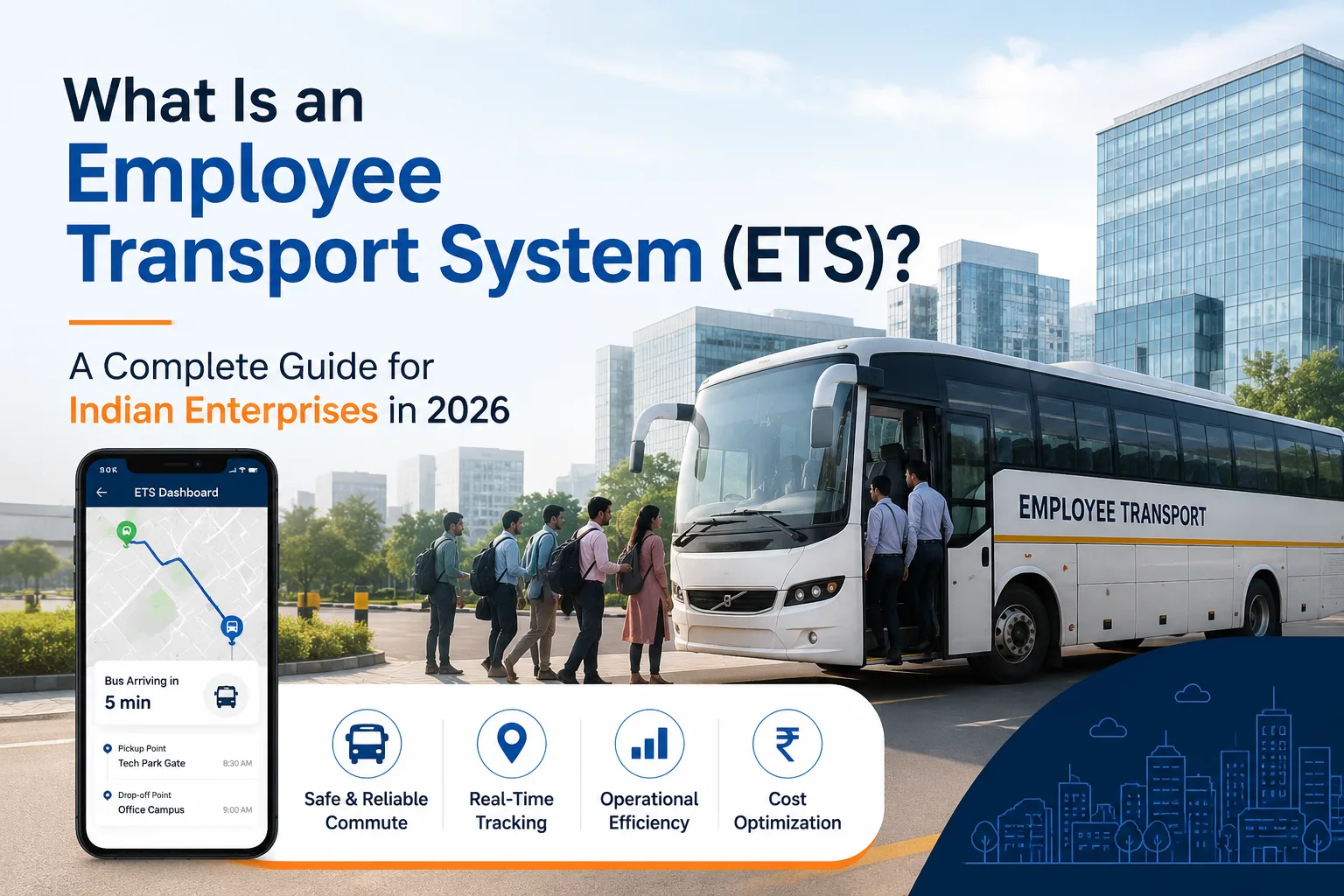
An employee transport system (ETS) is a software platform that manages every operational layer of corporate cab and bus services — from scheduling employee pickups and assigning vehicles to optimising routes, tracking live locations, and generating GST-compliant vendor invoices. For Indian enterprises managing 500 or more employees across shift-based operations, an ETS replaces a tangle of WhatsApp groups, manual rosters, and spreadsheet billing with a single coordinated system that runs with minimal coordinator intervention.
What Is an Employee Transport System?
An employee transport system is purpose-built operations software — not a general fleet tool, not a ride-hailing integration, not a GPS hardware solution. It is designed around the specific workflow of corporate mobility: fixed and semi-fixed employee pickup points, shift-based timing windows, duty of care obligations to employees, vendor cab empanelment, and billing processes that require both employee-level and trip-level audit trails.
The scope of an ETS covers:
- Employee registration and home address geocoding
- Automatic route and zone calculation based on employee locations
- Trip scheduling across single and multiple shifts
- Vehicle and vendor assignment per shift
- Real-time tracking for employees and coordinators
- SOS and safety features for employees in transit
- Vendor billing with GST compliance
- MIS reporting for HR, Admin, and Finance
What distinguishes an ETS from a generic fleet management tool is its employee-centric logic. Every function starts from the employee — not the vehicle. The system calculates routes based on where employees live, assigns vehicles based on shift capacity requirements, and generates billing based on actual employee trips completed. A fleet management system tells you where your cab is; an ETS tells you which employees are in it, whether they were picked up on time, and what the trip cost.
Why Indian Enterprises Need an ETS
Indian enterprises need an ETS when operational scale, vendor accountability gaps, safety obligations, and compliance requirements make manual transport coordination structurally untenable.
1. Scale That Breaks Manual Management
IT parks in Pune — Hinjewadi Phase 1, 2, and 3; Magarpatta City — and Bangalore — Electronic City, Whitefield, Manyata Tech Park — are not 50-employee operations. A single IT company at Hinjewadi Phase 3 can transport 2,000–5,000 employees daily across 15–30 shifts. Enterprises managing 500+ employees typically run a transport coordinator team of 2–4 people handling routing, vendor coordination, and billing. Without software, this team spends 60–70% of their working day on reactive fixes — missed pickups, capacity mismatches, vendor billing disputes — instead of proactive planning.
One roster error at 6:30 AM means a cab arrives empty while 12 employees wait on a Hinjewadi roadside. The HR escalation that follows generates more remedial work than 30 minutes of manual scheduling ever saved.
2. Vendor Accountability and Cost Control
Most Indian enterprises use a combination of empanelled cab vendors and in-house vehicles. Without an ETS, vendor billing is based on vendor-submitted trip sheets — a self-reported system with no independent verification. Vendors bill for trips that were cancelled, claim full-route charges for partial routes, and submit monthly invoices that take 3–4 weeks to reconcile because no one on the enterprise side has trip-level data to verify against.
An ETS generates its own trip-level record — the route taken, the employees transported, the vehicle deployed — and matches that against vendor claims automatically. Enterprises using ETS software typically reduce vendor billing disputes by 60–75% in the first quarter of deployment.
3. Employee Safety and Duty of Care Obligations
Supreme Court directives following the December 2012 Delhi case established clear duty of care precedents for corporate transport. Companies operating employee transport in India are expected to maintain live tracking of employee cab locations, panic/SOS access for employees, verified female employee safety protocols for late-night shifts, and auditable trip records. Manual systems cannot produce any of these. An ETS generates them by default.
For manufacturing facilities in Nashik — Mahindra, ABB, Siemens — where night shifts end at 2 AM, the ability for a security coordinator to track every returning cab in real time is an HR and legal requirement that WhatsApp coordination cannot fulfill.
4. GST Compliance and Audit Readiness
Corporate transport vendor payments fall under reverse charge mechanism (RCM) in many configurations, and direct vendor invoices must carry correct GST treatment for input tax credit eligibility. Manual billing processes frequently generate incorrect GST invoices — wrong HSN codes, missing RCM declarations, incorrect place of supply fields — that create ITC rejection risks during audit. An ETS with integrated GST billing generates compliant vendor invoices automatically, with correct HSN codes and tax components, reducing ITC rejection risk and audit exposure.
Key Features of a Modern Employee Transport System
A modern ETS covers six operational areas. Each one solves a specific problem that enterprises managing 300+ employees across multiple shifts cannot solve reliably with manual processes.
1. Intelligent Route Optimisation
The most operationally critical feature of an ETS is its route calculation engine. Route optimisation in an enterprise transport context is not mapping. It is: given 85 employee home addresses in a 12 km radius of the Hinjewadi IT park and a 12-seater vehicle, calculate the optimal pickup sequence that minimises total route length while ensuring no employee waits more than 25 minutes past their assigned pickup time. Optimised routes typically reduce total vehicle kilometres by 15–30% compared to manually planned routes — which means fewer vehicles needed, lower fuel consumption, and lower vendor billing.
2. Real-Time Employee Tracking and Notifications
Employees receive their pickup time, vehicle number, driver name, and a live tracking link for their cab. The link updates every 30–60 seconds and shows ETA to the employee's pickup point. This eliminates the most common transport helpdesk call in every corporate transport operation: "Where is my cab?" For a transport team managing 300 daily employee trips, eliminating 40–60 such calls per day recovers 1.5–2 hours of coordinator time daily — time that can be spent on exception management instead of status queries.
3. Shift-Based Scheduling and Roster Management
Enterprise transport operations run across multiple shifts — morning, afternoon, evening, night — with different employee sets, different routes, and different vehicle requirements for each shift. An ETS maintains shift definitions, employee shift assignments, and generates trip rosters automatically for each shift. When an employee's shift changes, the system recalculates their route assignment without coordinator intervention. Shift-based automation reduces roster preparation time from 3–4 hours per day (manual) to under 30 minutes, and eliminates the version-control problem of multiple coordinators editing the same Excel roster.
4. SOS and Emergency Response
Every employee-facing app in a properly built ETS includes a one-tap SOS button. When activated, it simultaneously alerts the corporate transport coordinator, sends the vehicle's live GPS location, and logs the timestamp with the employee's identity. For female employees on late-night return trips — a consistent operational concern in BPO operations in Chennai's Perungudi and Sholinganallur corridors — the SOS capability is a regulatory requirement under POSH guidelines and standard corporate policy, not an optional product feature. Enterprises deploying SOS-enabled ETS software report measurable improvements in female employee confidence in using late-night corporate transport.
5. Vendor and Vehicle Document Management
An ETS maintains the complete vendor empanelment record: vendor profile, vehicle list with RC and insurance validity dates, driver list with licence and badge validity, and rate cards per route or per km. When a vehicle's insurance is due for renewal in 30 days, the system alerts the transport coordinator automatically — not because someone remembered to check. This document validity management is particularly critical in manufacturing contexts: a vehicle with expired insurance entering a plant in Nashik triggers immediate security rejection, stranding employees at the gate and generating an incident report. Software-automated document alerts prevent this class of failure entirely.
6. Automated Billing and MIS Reporting
Transport billing in most Indian enterprises is a month-end crisis: collect vendor trip sheets, reconcile against internal records, approve or dispute, generate payment summaries for Finance. An ETS generates vendor billing continuously — every completed trip is billed against the vendor's approved rate card, with GST computed automatically. Month-end close reduces from 3–4 days of reconciliation to reviewing and approving a pre-computed statement. Finance gets route-level billing detail; HR gets employee-level trip records; Admin gets fleet utilisation data — all from the same system, no manual compilation required.
How an ETS Reduces Transport Costs
An ETS reduces corporate transport costs through four specific mechanisms. Here is a structured analysis for a 1,500-employee enterprise in Hinjewadi, running 120 vehicle-trips daily across three shifts:
| Cost Category | Without ETS | With ETS | Reduction |
|---|---|---|---|
| Vehicles required (route optimisation) | 45 cabs/day | 33 cabs/day | 27% |
| Vendor overbilling disputed monthly | ₹3.5 lakh | ₹90,000 | 74% |
| Coordinator FTEs required | 4 FTEs | 2 FTEs | 50% |
| Monthly billing reconciliation time | 4 days | 0.5 days | 87% |
Across these categories, enterprises deploying ETS software typically see total transport cost reductions of 20–35% in the first year. The largest single component is vehicle count reduction through route optimisation — because each vehicle eliminated saves not just fuel but vendor payment. In Pune and Bangalore, a 12-seater empanelled cab costs ₹18,000–₹28,000 per month. Eliminating 12 vehicles through better routing saves ₹2.16 lakh–₹3.36 lakh per month before any billing dispute recovery is counted.
How to Choose the Right ETS for Your Company
Choosing an ETS requires five specific evaluations — not a feature checklist, but operational questions whose answers reveal whether the software was built for your actual complexity or for a simpler use case.
1. Does It Handle Your Shift Complexity?
Not all ETS platforms are built for multi-shift operations. Some handle single-shift morning/evening commutes well but break down under 4-shift manufacturing operations where shift timings change weekly. Ask the vendor to demonstrate 4-shift scheduling with staggered start times and dynamic shift assignments — not on a demo dataset but on a configuration that reflects your shift structure. The answer tells you whether the product was designed for BPO-style single-shift IT transport or for real enterprise complexity.
2. Does It Have Driver and Employee Mobile Apps?
An ETS without mobile apps for both drivers and employees is a backend scheduling tool, not a transport management system. The driver app must show the trip route, pickup sequence, employee details at each stop, and allow real-time exception reporting (employee not at stop, vehicle breakdown). The employee app must show pickup ETA, driver details, and SOS. If either app is a clunky web view or missing entirely, the real-time tracking value disappears — and you are back to coordinators fielding "where is my cab?" calls.
3. How Does It Handle Vendor Billing Specifically?
Get specific. Ask: does the system generate GST invoices automatically? Does it support both fixed-rate and per-km rate cards? Can it handle route-level, employee-level, and vehicle-level billing granularity? Can Finance export the billing data to your ERP in a format your Accounts Payable process accepts? A system that generates a PDF invoice for the vendor is not billing automation — it is digital paper. The billing module is where most ETS platforms are weakest and where your Finance team will spend the most time if the software is insufficient.
4. What Are the Data Privacy and Employee Consent Provisions?
Employee location tracking for transport purposes requires explicit consent under India's Digital Personal Data Protection Act 2023. An ETS must have built-in employee consent workflows at onboarding, a defined data retention policy, and the ability to export or delete employee data per request. Ask the vendor for their data processing agreement and their data retention period. An ETS vendor who has not thought about DPDPA compliance is a compliance risk for your enterprise, not just a product immaturity signal.
5. What Does Implementation Actually Look Like?
The gap between demo and deployment is where most ETS projects fail. A 1,500-employee enterprise needs: employee data import with address geocoding verification, route configuration across all shifts, vendor rate card entry, driver onboarding, and employee app communication. Ask for a named implementation timeline with week-by-week milestones. "2–3 weeks to go live" without specifics is a warning sign. Ask for a reference customer of similar size and shift complexity who went live in the stated timeline — and call them.
Frequently Asked Questions
What is the difference between an ETS and a fleet management system?
A fleet management system tracks vehicles — their location, fuel consumption, maintenance schedules, and utilisation. An employee transport system starts from employees — their home addresses, shift assignments, and pickup requirements — and uses that data to plan routes, assign vehicles, track trips, and generate billing. The two solve different problems: fleet management is vehicle-centric, ETS is employee-centric. An enterprise can run an ETS with no in-house vehicles at all — all vendor cabs — because the ETS manages the trip, not the asset. Some enterprises use both: fleet management for their owned vehicles and ETS for the employee transport workflow that runs on top of both owned and empanelled vehicles.
How long does it take to implement an ETS for a 1,000-employee enterprise?
For a 1,000-employee enterprise with 3 shifts and 30–40 empanelled vehicles, a well-designed ETS implementation takes 3–6 weeks from kickoff to full operation. The critical path is data preparation — employee address geocoding, route zone validation, and vendor rate card configuration — not the software setup itself. Enterprises with clean employee data (verified addresses, complete contact details, accurate shift assignments in their HRMS) go live at the 3-week end of the range. Those who discover data quality issues mid-implementation extend to 6–8 weeks. The implementation timeline is a good proxy for software quality: vendors who give you a specific data preparation checklist upfront are more experienced than those who offer vague "we'll handle it" assurances.
Can an ETS integrate with our HRMS for employee data?
Most modern ETS platforms offer HRMS integration via API or file-based sync. The integration syncs employee joining, resignation, and shift change events so the transport roster updates automatically without manual coordinator intervention. Common integrations in Indian enterprises include SAP SuccessFactors, Darwinbox, Keka, and Zoho People. Before committing to an integration promise, ask for a specific working reference — not "yes we can integrate" but "here is the integration we built for a 2,000-employee IT company on Darwinbox in Chennai." Integration quality varies significantly between ETS vendors, and a broken HRMS sync is a data quality problem that cascades into wrong rosters and billing errors.
Is an ETS cost-effective for enterprises under 200 employees?
For enterprises under 200 employees running a single shift on 2–3 fixed routes, a full ETS may not justify its cost if transport is handled by vendors on fixed monthly contracts with minimal variation. The ROI calculation changes at 300+ employees across multiple shifts, where route optimisation savings, vendor billing reconciliation time, and coordinator overhead create enough cost reduction to recover the software cost within 2–3 months. Under 200 employees, evaluate honestly whether your transport operation is actually simple — or whether it has complexity that looks manageable until it produces an incident.
How does an ETS handle ad hoc cab requests outside the scheduled route?
Scheduled route trips are the core of any ETS, but enterprise transport always has exceptions — late-working employees who miss their shift cab, site visits, airport transfers, and client pickups. A well-designed ETS includes an ad hoc booking module where employees or their managers can request point-to-point trips outside the scheduled route, subject to coordinator approval and available vehicle assignment. These ad hoc trips are tracked, billed, and reported with the same audit trail as scheduled trips. Without this, Finance ends up with a separate petty cash category for "miscellaneous cabs" that reconciles to nothing — a common source of transport budget leakage in enterprises that run ETS for scheduled trips but handle exceptions manually.
Conclusion
An employee transport system is not a cost centre — it is cost infrastructure. The enterprises that treat transport coordination as an ad hoc administrative function absorb its failures in HR escalations, vendor billing disputes, compliance gaps, and coordinator burnout. The enterprises that deploy a properly scoped ETS typically see the investment return within the first quarter through vehicle count reduction alone — before the vendor billing recovery and coordinator time savings are counted.
The right time to evaluate an ETS is before the next transport incident forces the conversation. If your transport team is managing more than 300 employees across multiple shifts and spending more working hours on reactive fixes than on planned operations, the structural problem will not improve with more coordinators — it requires a different system.
Track My Tour's employee transport system is built for Indian enterprise complexity — multi-shift operations, empanelled vendor management, GST-compliant billing, and employee safety features that meet corporate policy requirements. Bring your actual shift structure, employee count, and vendor setup to a free demo and we will show you exactly how it maps to the software — and what the realistic savings look like for your operation.
Book a free 30-minute demo with the Track My Tour team.