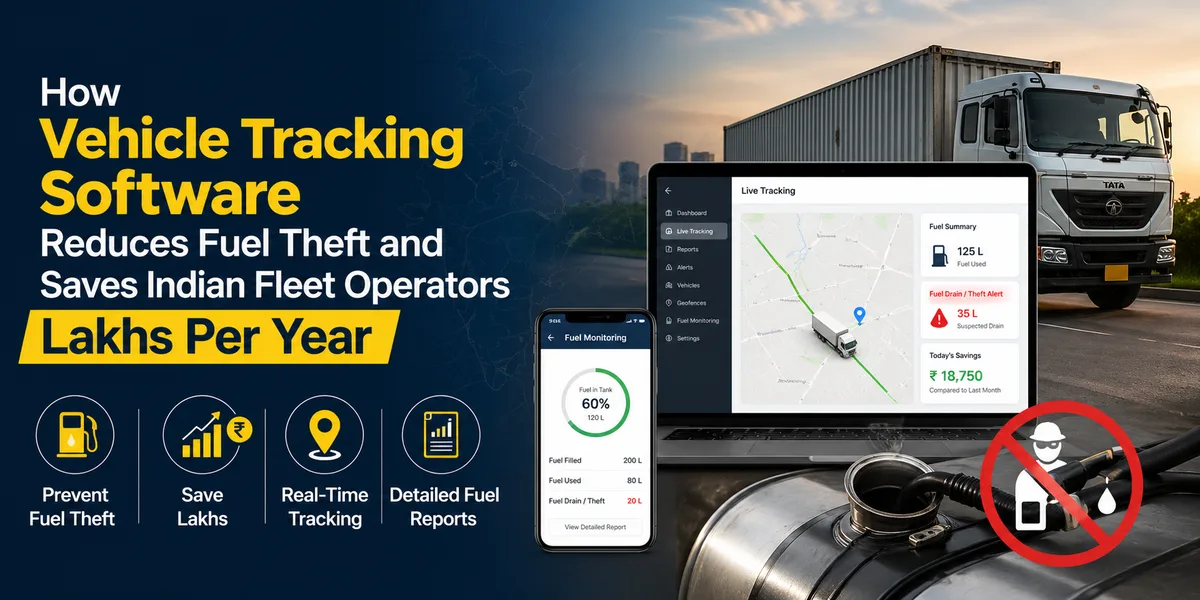
Fuel is the single largest variable cost in running an Indian fleet — typically 30–40% of total operating expenses. And for most operators without vehicle tracking software, it is also the most poorly controlled cost line in the business. Driver-submitted fuel claims are taken on trust. Odometer readings are manual. Route deviations go undetected. Idle time accumulates invisibly. The result: operators pay for fuel they cannot verify was consumed on their vehicles for their trips. Vehicle tracking software closes every one of these gaps — and the fuel savings it creates are typically the fastest-returning ROI in the entire technology investment.
This guide covers the six specific mechanisms through which vehicle tracking software reduces fuel costs and prevents fuel theft in Indian fleets, the realistic savings numbers operators achieve, and how to calculate the ROI for your specific fleet size and fuel spend.
How Vehicle Tracking Software Reduces Fuel Costs
Vehicle tracking software reduces fuel costs through six distinct mechanisms — each addressing a different category of leakage. Some are fraud prevention; others are efficiency improvements. Together, they typically add up to a 15–25% reduction in fleet fuel spend within the first 90 days of deployment.
Quick Answer: Vehicle tracking software reduces fleet fuel costs by cross-referencing driver fuel claims against GPS-verified mileage (eliminating fraudulent fill-up claims), detecting idle time (fuel consumed with zero distance travelled), catching route deviations (extra distance driven beyond the planned route), verifying vehicle efficiency against benchmarks, preventing unauthorised vehicle usage, and providing the data for objective driver performance conversations that change fuel-wasting driving behaviour.
Mechanism 1: GPS Mileage vs. Fuel Fill-Up Cross-Referencing
The most direct fuel fraud prevention vehicle tracking offers is the automatic cross-referencing of every driver fuel claim against GPS-recorded trip distance. When a driver submits a fuel expense — "Filled 50 litres at ₹94/litre, ₹4,700" — the system calculates what that 50 litres should have covered given the vehicle's certified fuel efficiency and the GPS-verified distance since the last fill-up. If the GPS says the vehicle travelled 420 km and the vehicle averages 14 km/l, the expected fuel consumption is 30 litres — not 50. A 20-litre discrepancy worth ₹1,880 is flagged automatically for coordinator review.
The deterrent effect is significant even before any individual claim is investigated. Drivers who know their fuel claims are automatically cross-referenced against GPS data tend to submit accurate claims from day one — the fraudulent 10–20% inflation disappears immediately because it's no longer undetectable. Operators who implement GPS-verified expense logging typically see reported fuel consumption drop 10–18% in the first month, primarily through the deterrent effect.
Mechanism 2: Idle Time Monitoring and Alerts
A vehicle idling for one hour burns approximately 0.6–1.0 litres of fuel with zero distance travelled. For a 30-vehicle fleet where each vehicle idles for an average of 45 minutes per day — waiting at pickup points, in traffic without forward movement, with AC running between trips — the daily idle fuel consumption is 270–450 litres. At ₹94/litre, that's ₹25,000–₹42,000 daily, or ₹75–₹1.25 lakh monthly, in fuel burned with no productive distance covered.
Vehicle tracking software flags vehicles that idle beyond a configurable threshold — typically 10–15 minutes. When an alert triggers, coordinators can contact the driver to ask them to shut the engine, or investigate whether the idle is genuine (waiting for a delayed passenger) or unnecessary (driver resting between trips with AC running). Over 60–90 days of monitoring and feedback, average idle time per vehicle typically reduces by 40–60%, recovering a significant portion of the idle fuel cost. See: How GPS Vehicle Tracking Works for Indian Fleet Owners.
Mechanism 3: Route Deviation Detection
Every trip has a planned route — the optimal path from pickup to drop. When a driver deviates significantly from the planned route, the extra distance consumes additional fuel (and potentially generates illegitimate distance claims if billing is distance-based). Vehicle tracking software records the actual route taken for every trip and compares it against the planned route, flagging significant deviations automatically.
Route deviations happen for legitimate reasons (traffic, road closures) and illegitimate ones (driver making a personal stop, taking a longer route on a per-km billing arrangement). The ability to review trip history for any vehicle on any date means coordinators can investigate any unusual deviation with actual GPS evidence rather than asking the driver to explain without data. Over time, the knowledge that route data is recorded changes driver behaviour more effectively than any policy memo.
Mechanism 4: Prevention of Unauthorised Vehicle Usage
In operations where vehicles are parked overnight at the driver's residence (common in Indian tour operations), unauthorised usage — the driver using the vehicle for personal trips during off-hours — is a real and consistent fuel cost. Vehicle tracking software's geofencing feature alerts coordinators when a vehicle moves outside its designated parking location during off-hours. The alert is immediate; the investigation can happen the next morning with GPS evidence of exactly where the vehicle went and for how long.
Operators who implement overnight geofencing alerts typically identify 2–5 drivers per 30-vehicle fleet who are regularly using vehicles for personal purposes — each contributing to fuel spend of ₹3,000–₹8,000 per month in unauthorised usage that was previously invisible.
Mechanism 5: Vehicle Efficiency Benchmarking
Not all vehicles perform to their rated efficiency — particularly as they age. Tyres underinflated by 10 PSI reduce fuel efficiency by 2–3%; a dirty air filter by 5–10%; and worn spark plugs by up to 10%. Without GPS-verified mileage cross-referenced against fuel consumption, a vehicle with a maintenance issue causing 15% worse fuel efficiency will continue operating below standard because the problem is invisible in manual records.
Vehicle tracking software generates per-vehicle fuel efficiency reports over time, making it immediately visible when a specific vehicle's consumption rises above its historical baseline or above the fleet average for its class. This triggers a targeted maintenance investigation — rather than discovering the problem only when the vehicle breaks down with a significantly more expensive repair.
Mechanism 6: Driver Behaviour Improvement Through Data-Driven Feedback
Aggressive driving — hard acceleration from stops, rapid speed changes, harsh braking — increases fuel consumption by 15–30% compared to smooth driving on the same route. GPS-derived driver behaviour scores (based on detected harsh braking events, rapid acceleration, and speed violations) give fleet managers objective data for driving behaviour conversations with individual drivers. Instead of vague feedback that creates defensiveness, the conversation is specific: "Your fuel efficiency score for March was 8.4 km/l vs. the fleet average of 11.2 km/l for the same vehicle class. Your harsh braking count was 4.2 events per trip vs. fleet average of 0.8."
Data-driven driver feedback combined with a driving performance component in bonus calculations changes driving behaviour durably. Operators who implement driver efficiency scoring and tie it to financial incentives typically see fleet-wide fuel efficiency improve by 8–15% within two quarterly review cycles.
ROI Calculation for Vehicle Tracking Fuel Savings
Here's a realistic ROI calculation for a 30-vehicle Indian tour fleet spending ₹3 lakh per month on fuel:
| Savings Source | % Reduction | Monthly Saving (₹) |
|---|---|---|
| GPS claim cross-referencing (deterrent) | 10–12% | ₹30,000–₹36,000 |
| Idle time reduction (40–60% idle reduction) | 4–6% | ₹12,000–₹18,000 |
| Route deviation prevention | 2–3% | ₹6,000–₹9,000 |
| Unauthorised usage elimination | 2–4% | ₹6,000–₹12,000 |
| Driver behaviour improvement | 3–5% | ₹9,000–₹15,000 |
Total monthly saving: ₹63,000–₹90,000 (21–30% of ₹3 lakh fuel spend)
Annual saving: ₹7.5 lakh–₹10.8 lakh
Software cost (app-based, 30 vehicles): ₹600/vehicle/month × 30 = ₹18,000/month = ₹2.16 lakh/year
Net annual benefit: ₹5.3 lakh–₹8.6 lakh
Payback period: 5–8 weeks
How to Get Started
The fastest path to realising fuel savings from vehicle tracking is app-based deployment — no hardware installation required, zero upfront hardware cost, and driver app deployed in 1–2 days. The full fuel monitoring workflow (driver expense logging, GPS mileage cross-referencing, idle time alerts, route deviation detection) can be active within 3–5 days of starting implementation for most Indian fleet sizes.
The most important first step is not the technology — it's communicating the change to your drivers correctly. Frame it as data-driven fleet management, not surveillance: "We're implementing GPS tracking so we can verify trip records accurately for billing, prevent document issues, and use real data for payroll calculations." Drivers who understand how the system benefits them (faster expense reimbursement, accurate trip records for dispute resolution) adopt it faster than drivers who experience it as imposed monitoring.
Frequently Asked Questions
How much fuel can Indian fleets realistically save with vehicle tracking software?
Indian fleet operators who implement vehicle tracking software with GPS-verified expense logging, idle time monitoring, and driver behaviour scoring typically reduce fuel costs by 15–25% within the first 90 days. On a fleet spending ₹3 lakh per month on fuel, this translates to ₹45,000–₹75,000 in monthly savings. The exact figure depends on baseline leakage (fleets with significant existing fraud recover faster) and driver adoption quality (fleets with well-managed transitions achieve behaviour improvements faster).
How does vehicle tracking detect driver fuel fraud?
Vehicle tracking software detects fuel fraud by cross-referencing every fuel fill-up claim against GPS-verified trip distance and the vehicle's certified fuel efficiency. If a driver claims 60 litres consumed but GPS data shows only 520 km driven at a certified 14 km/l efficiency (expected consumption: 37 litres), the 23-litre discrepancy is flagged automatically for coordinator review. The system doesn't require catching a driver in the act — the mathematical discrepancy between claimed and expected consumption is sufficient evidence for investigation.
What counts as excessive idle time in vehicle tracking?
Industry standard for idle time alerts is 10–15 minutes of engine running with no vehicle movement. For Indian tour operations, legitimate idle time includes: waiting for a delayed passenger at the airport (typically 10–30 minutes), traffic stops of short duration, and engine running for AC while waiting for a confirmed pickup. Alerts for idling beyond 15 minutes prompt coordinator check-in without being disruptive in legitimate waiting scenarios. The goal is identifying idle time that has no operational justification — not eliminating all engine-on waiting time.
Is app-based or hardware-based vehicle tracking better for fuel monitoring?
App-based vehicle tracking provides all the GPS data needed for fuel monitoring: trip distance (to cross-reference fill-up claims), route history (to detect deviations), idle time (engine on, no movement), and speed data (for driver behaviour scoring). Hardware-based GPS devices add continuous tracking independent of driver phone status but don't improve fuel monitoring accuracy for chauffeur-driven fleets where the driver is always present. App-based tracking delivers the same fuel savings at zero hardware cost — the right choice for most Indian tour and car rental operators.
How do drivers react to fuel monitoring through GPS tracking?
Driver reactions vary based on framing. Operators who introduce GPS tracking as "we're monitoring you" face resistance. Operators who frame it as "we're using GPS data to verify trip records for accurate payroll, faster expense reimbursement, and customer billing" see significantly better adoption. Drivers whose expenses are now processed in 48 hours instead of month-end (because the GPS data validates the claim) become advocates for the system. The drivers who resist most strongly are typically those whose expense claims don't survive GPS scrutiny — which is the outcome the system is designed to produce.
Further Reading
- How GPS Vehicle Tracking Works for Indian Fleet Owners
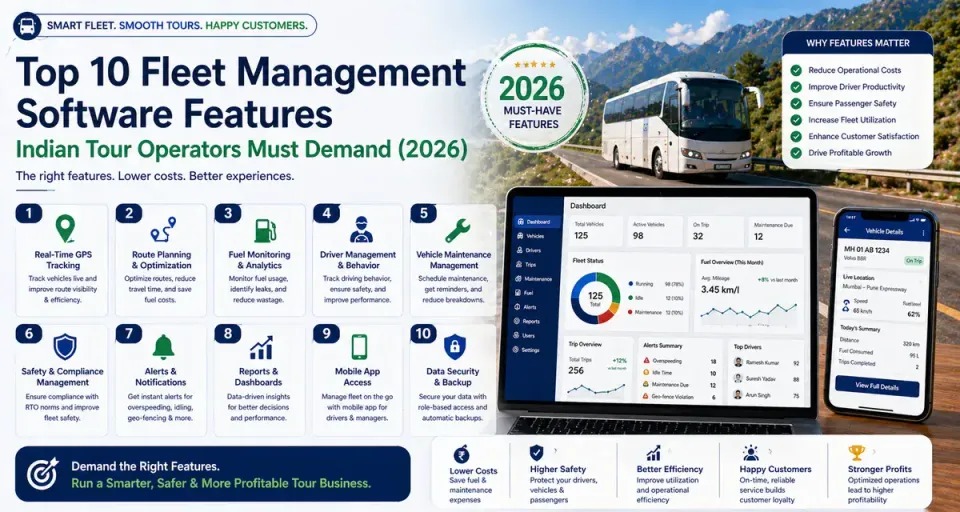
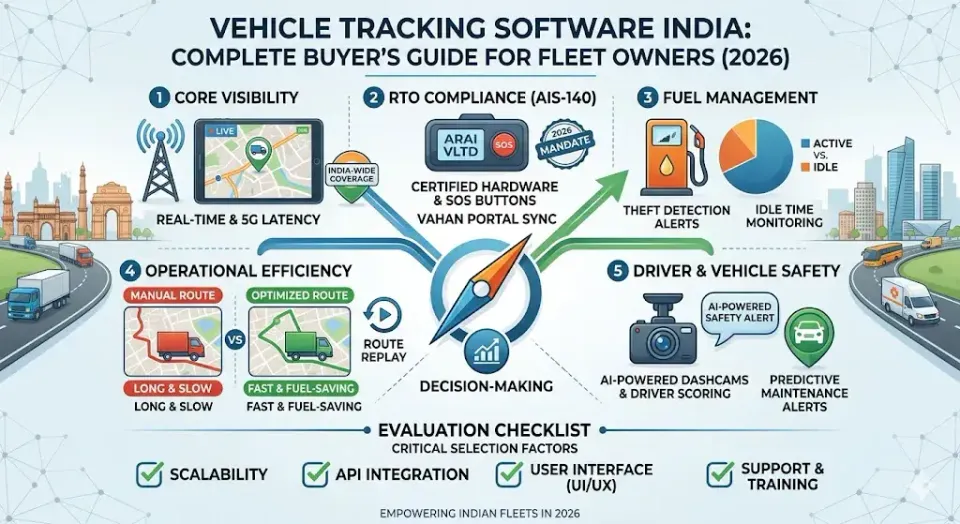
- Vehicle Tracking Software India: Complete Buyer's Guide
- Best Fleet Management Software in India for Tour Operators (2026)
Calculate Your Fleet's Fuel Savings Potential
The starting point for any fuel saving initiative is a baseline audit: what is your current monthly fuel spend, and what percentage is verifiable against GPS-recorded trip data? For most Indian operators without tracking software, the answer to the second question is zero — which means the baseline leakage is impossible to measure without implementing tracking first.
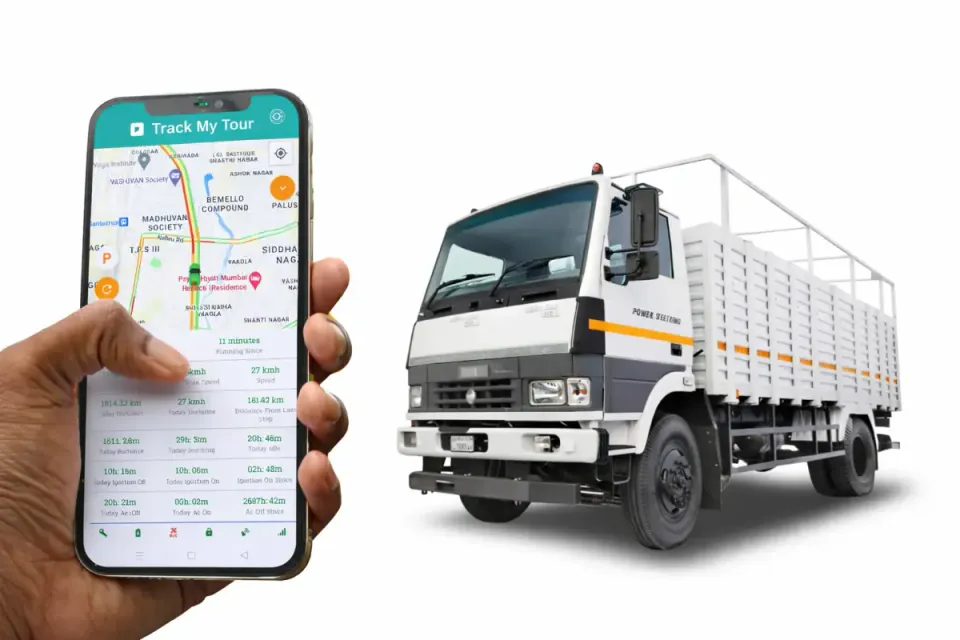
Track My Tour includes GPS-integrated fuel monitoring as a core feature. In the first demo, we'll build a rough savings estimate for your fleet size and average monthly fuel spend — giving you a before-you-buy projection to evaluate against the subscription cost. Book a free 30-minute demo and let's quantify what's leaking from your fuel budget.