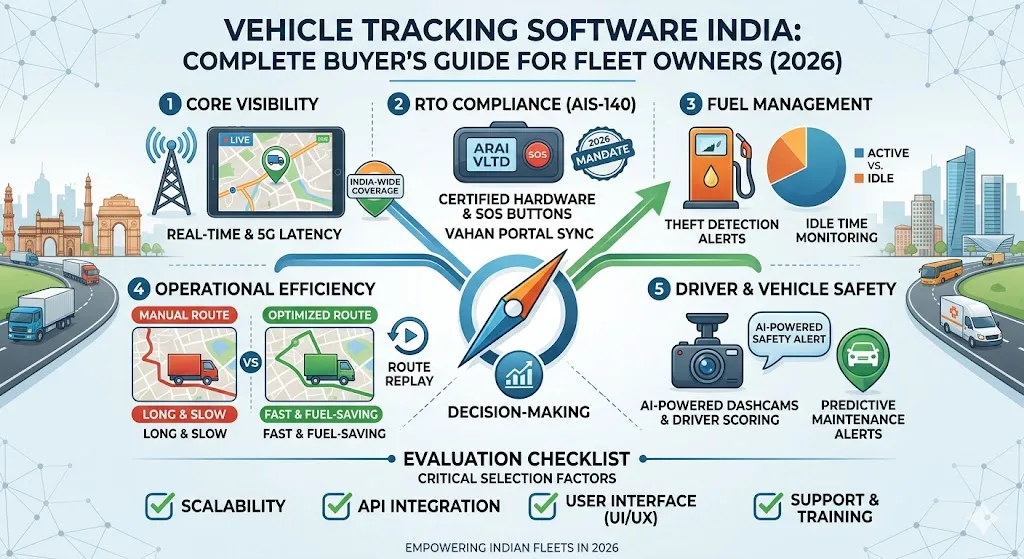
Vehicle tracking software has gone from a luxury to an operational necessity for Indian fleet owners — and the options in 2026 range from basic GPS hardware sold on Flipkart to enterprise-grade platforms covering live tracking, driver behaviour, fuel verification, and customer-facing trip links. Choosing poorly means paying for features you'll never use, or going live with a system that can't scale past 20 vehicles. This guide gives fleet owners and tour operators the framework to evaluate vehicle tracking software in India without getting sold to.
We'll cover what vehicle tracking software actually does, the difference between app-based and hardware-based systems, the features Indian operators actually use (versus the ones that look impressive in demos), and what the real cost of ownership looks like for a 20–100 vehicle fleet.
What Is Vehicle Tracking Software?
Vehicle tracking software is a platform that uses GPS technology to record and display the real-time location of every vehicle in your fleet. Beyond basic location, modern platforms capture trip history, speed, idle time, route deviations, fuel fill-ups, and driver behaviour data — making the information actionable for operations managers, not just visible on a map.
Quick Answer: Vehicle tracking software shows you where every vehicle in your fleet is, where it has been, how it was driven, and what it consumed — in real time and historically. For Indian tour operators and car rental businesses, this translates directly to fewer "where is my vehicle?" calls, better fuel control, faster billing, and lower insurance risk.
For tour operators specifically, vehicle tracking is inseparable from trip management. A tracking system that only shows a dot on a map misses the point. The location needs to be contextualised against the trip it's executing — so coordinators can see whether the vehicle is on time, ahead, or delayed relative to its pickup commitment.
App-Based Tracking vs. GPS Hardware Devices
This is the decision that affects your upfront cost, installation complexity, and flexibility the most. Understanding the trade-offs is essential before speaking to any vendor.
GPS Hardware Devices
Dedicated GPS hardware (OBD-II plug-in devices or hardwired units) transmits location independently of the driver's phone. The device draws power from the vehicle and sends data over a SIM-based connection. Advantages include continuous tracking even when the driver's phone is off and tamper-evidence (the vehicle's location is reported regardless of driver behaviour). Disadvantages include ₹3,000–₹8,000 per-vehicle upfront cost, professional installation, SIM plan management, and hardware failure risk.
App-Based GPS Tracking
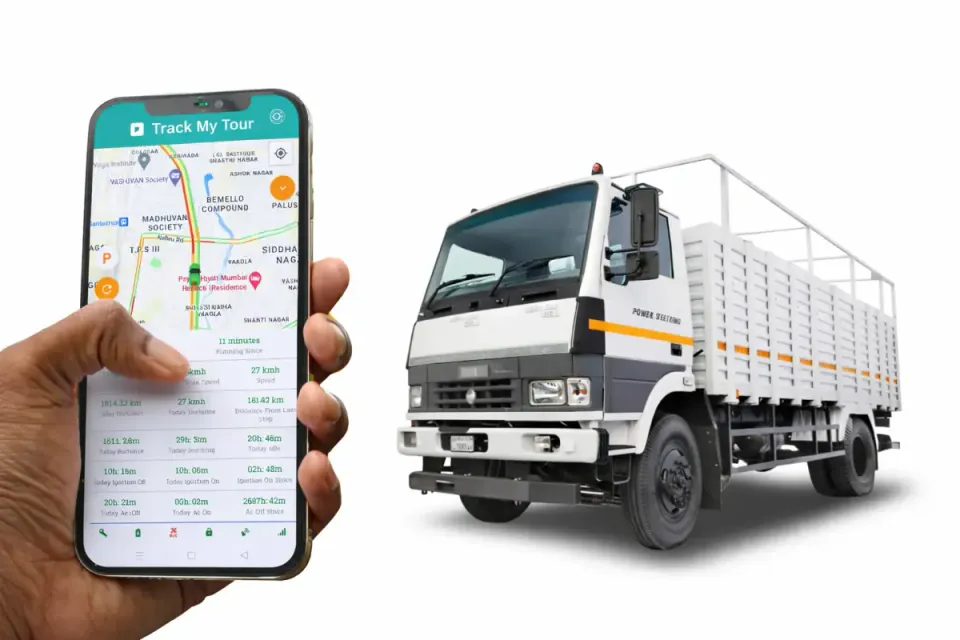
App-based tracking uses the GPS receiver in the driver's existing Android smartphone, with a driver app transmitting location over the phone's data connection. Zero hardware cost, same-day deployment, no installation required. The driver app also enables trip acceptance, expense logging, customer communication, and duty slip receipt — creating a complete field workflow from a single app. The trade-off: tracking is active only when the driver app is running and the phone is powered. For chauffeur-driven and tour operations where the driver is always present, this is a non-issue in practice.
For most Indian tour operators and car rental operators: App-based vehicle tracking delivers everything they need at a fraction of the hardware cost. GPS hardware is best justified for high-value vehicles in industries where driver presence can't be assumed (logistics, heavy equipment).
Key Features Indian Fleet Operators Actually Use
1. Live Map View
Real-time location of every active vehicle on a single map. The map should update every 15–30 seconds, show vehicle label (registration or driver name), and indicate whether the vehicle is moving, idle, or stopped. Your operations coordinator answering a client call at 9 PM should be able to see where the vehicle is in under three seconds — no phone call to the driver required.
2. Trip History and Playback
Every completed trip should be fully replayable — the exact route taken, speed at each point, stops made, idle periods, and total distance. This is essential for three scenarios: billing disputes (verifying distance claimed matches distance driven), customer complaint resolution (proving the driver took the correct route), and insurance claims (providing an exact record of vehicle position at time of incident).
3. Shareable Customer Tracking Links
For tour operators and car rental businesses, customer-facing tracking links transform the customer experience. The moment a vehicle departs for a pickup, the customer receives a link showing live vehicle location and estimated arrival — no more "where is my car?" calls. This feature alone reduces inbound customer service calls by 40–60% in the first month of deployment.
4. Geofencing and Alerts
Define virtual boundaries around key locations — hotel zones, airport terminals, client offices. When a vehicle enters or exits, the system triggers an automatic alert to the coordinator. This is particularly useful for corporate car rental clients who need confirmation of vehicle arrival at their facility, and for monitoring whether vehicles are deviating from assigned routes.
5. Idle Time Monitoring
Unnecessary idling is a significant and often invisible fuel cost. A vehicle idling for 30 minutes burns approximately 0.3–0.5 litres of fuel — multiplied across a fleet of 30 vehicles over 300 working days, idle time can account for ₹1–₹2 lakh in wasted fuel annually. Vehicle tracking software flags vehicles that idle beyond a configurable threshold (typically 10–15 minutes), enabling operations managers to investigate and address the pattern.
6. Fuel Expense Verification
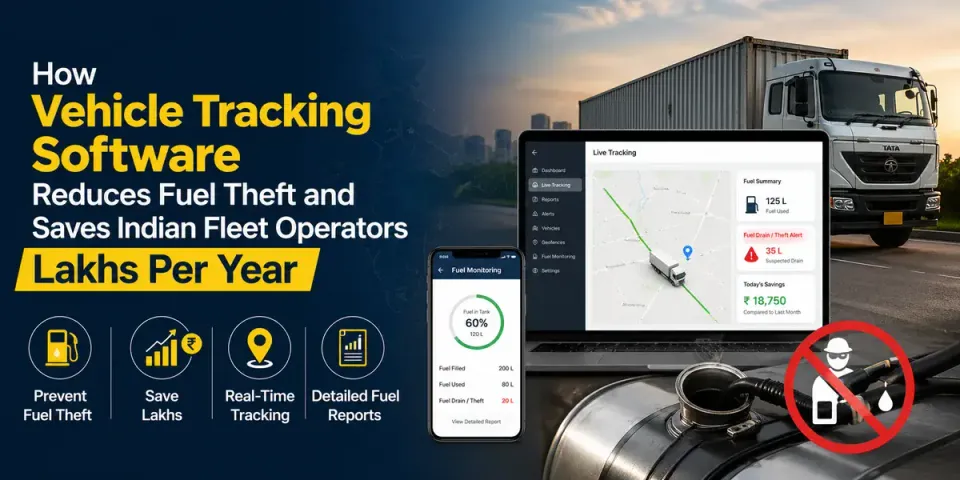
GPS-recorded trip distance cross-referenced against driver-submitted fuel fill-ups is the most effective fuel leakage control available to Indian fleet operators. See: How Vehicle Tracking Software Saves Indian Fleets Lakhs Per Year. The math is simple: if a driver claims 8 fill-ups totalling 400 litres in a month, but GPS records show 3,200 km driven and the vehicle's certified efficiency is 12 km/l, the expected fuel consumption is 267 litres. The 133-litre discrepancy is worth ₹15,000+ at current diesel prices.
7. Driver Behaviour Scoring
Speed violations, harsh braking, and rapid acceleration are all detectable through app-based GPS data. Aggregating this data per driver produces a behaviour score that fleet managers can use in performance conversations — moving from vague feedback ("you drive recklessly") to specific data ("you averaged 4 harsh braking events per trip in April vs. 1.2 for the fleet average"). This creates a foundation for objective performance management and targeted driver training.
AIS-140 and Government Compliance Requirements
The Automotive Industry Standard AIS-140 mandates GPS tracking on all public service vehicles in India, including tourist vehicles, taxis, and buses. The standard specifies real-time location transmission, emergency alert capability, and data format requirements. While compliance enforcement has been uneven across states, many state transport authorities now require AIS-140-compliant devices as a condition of tourist vehicle permit renewal.
If you operate tourist-category vehicles, verify that your tracking software and hardware meet AIS-140 certification requirements before your next permit renewal. Non-compliant vehicles are increasingly facing detention during inspections in Maharashtra, Karnataka, and Rajasthan.
5 Red Flags When Evaluating Vehicle Tracking Software
- Demo that only shows the map view: If the vendor's demo focuses entirely on the live map and doesn't walk you through trip history, fuel verification, billing integration, or driver app workflow — those features either don't exist or don't work well.
- No offline driver app mode: In remote areas, hill stations, or tunnels, connectivity drops. Trip records should be stored locally on the driver's phone and synced when connectivity is restored — not lost.
- Hardware-first vendor who can't explain app-based tracking: This usually means they have hardware inventory to move and the app is an afterthought.
- No Indian compliance features: A platform that doesn't handle GST invoicing, Indian vehicle document formats, or Indian map data (OSM or Google Maps India) wasn't built for this market.
- Per-device pricing without per-feature transparency: Some vendors bundle cheap tracking with expensive add-ons (analytics, API access, support) that inflate the real cost significantly above the advertised per-device rate.
Real Cost of Ownership for Indian Fleet Operators
The true cost of vehicle tracking software includes more than the subscription price. For a 30-vehicle fleet:
- App-based platform: ₹600/vehicle/month × 30 = ₹18,000/month. Zero hardware cost. Total Year 1: ₹2.16 lakh.
- Hardware-based platform: ₹5,000 hardware/vehicle × 30 = ₹1.5 lakh upfront + ₹500/vehicle/month × 30 = ₹15,000/month. Total Year 1: ₹3.3 lakh.
Against that cost, measure the value: a 15% fuel saving on a fleet spending ₹3 lakh/month on fuel = ₹5.4 lakh/year. Customer service call reduction, billing accuracy improvement, and compliance fine avoidance add further measurable returns. The payback period for well-implemented vehicle tracking software on a 30-vehicle Indian fleet is typically under 60 days.
Frequently Asked Questions
What is the best vehicle tracking software for Indian tour operators?
The best vehicle tracking software for Indian tour operators is one that combines real-time GPS tracking, customer-shareable trip links, driver app functionality for expense logging and trip management, integration with duty slip and invoice generation, and vehicle document compliance alerts. App-based platforms that don't require dedicated GPS hardware offer the best cost of ownership and fastest deployment for chauffeur-driven fleets. Verify that the platform handles Indian map data, GST invoicing, and AIS-140 compliance if you operate tourist-category vehicles.
How much does vehicle tracking software cost in India?
App-based vehicle tracking software in India is typically priced between ₹400 and ₹1,200 per vehicle per month. Hardware-based systems add ₹3,000–₹8,000 per vehicle in upfront device costs plus a ₹300–₹600/vehicle/month subscription. For a 30-vehicle fleet, the total Year 1 cost of app-based tracking is 35–50% lower than hardware-based systems, with faster deployment and zero installation complexity.
Can vehicle tracking software work without GPS hardware?
Yes. App-based vehicle tracking uses the GPS receiver built into the driver's Android smartphone. The driver app records location at regular intervals and transmits data over 4G. For chauffeur-driven fleets and tour operations — where the driver is always present and the app is actively running — app-based tracking provides all the live location, trip history, and driver behaviour data that hardware-based systems offer, at zero hardware cost. The only scenario where hardware tracking has a meaningful advantage is when you need to track vehicles independently of driver phone behaviour (e.g., unattended vehicles, high-theft risk environments).
How long does it take to deploy vehicle tracking for a 30-vehicle fleet?
App-based vehicle tracking for a 30-vehicle fleet can be fully deployed in 2–4 days: driver app installation on all phones (typically 1–2 hours with drivers present), coordinator dashboard training (2–3 hours), and a test run of the full trip workflow. Hardware-based systems require installation appointments for each vehicle, taking 1–2 weeks depending on installer availability. Cloud-based platforms require no server setup or IT involvement.
Is AIS-140 GPS tracking mandatory for tourist vehicles in India?
AIS-140 GPS tracking is mandated for all public service vehicles under the Motor Vehicles (Amendment) Act 2019, including tourist vehicles, maxi cabs, and taxis. Enforcement varies by state, but Maharashtra, Karnataka, Delhi, and Rajasthan are actively requiring AIS-140-compliant devices during permit renewals and inspections. If you operate tourist-category vehicles, verify that your tracking system meets AIS-140 certification requirements before your next permit cycle.
Further Reading
- How GPS Vehicle Tracking Works for Indian Fleet Owners
- Best Fleet Management Software in India for Tour Operators (2026)
- How Vehicle Tracking Software Saves Indian Fleets Lakhs Per Year
- Vehicle Document Management for Indian Fleets
Get Live Tracking Across Your Entire Fleet
The best way to evaluate vehicle tracking software is a live demo with your own fleet size and workflow. Ask the vendor to show you: live map view, trip playback, driver app on an actual Android phone, customer tracking link generation, and how fuel fill-ups are cross-referenced against GPS distance.
Track My Tour includes comprehensive vehicle tracking as part of its fleet management platform, purpose-built for Indian tour operators and car rental businesses. Book a free 30-minute demo — we'll walk you through the full tracking workflow using your vehicle types and trip patterns.