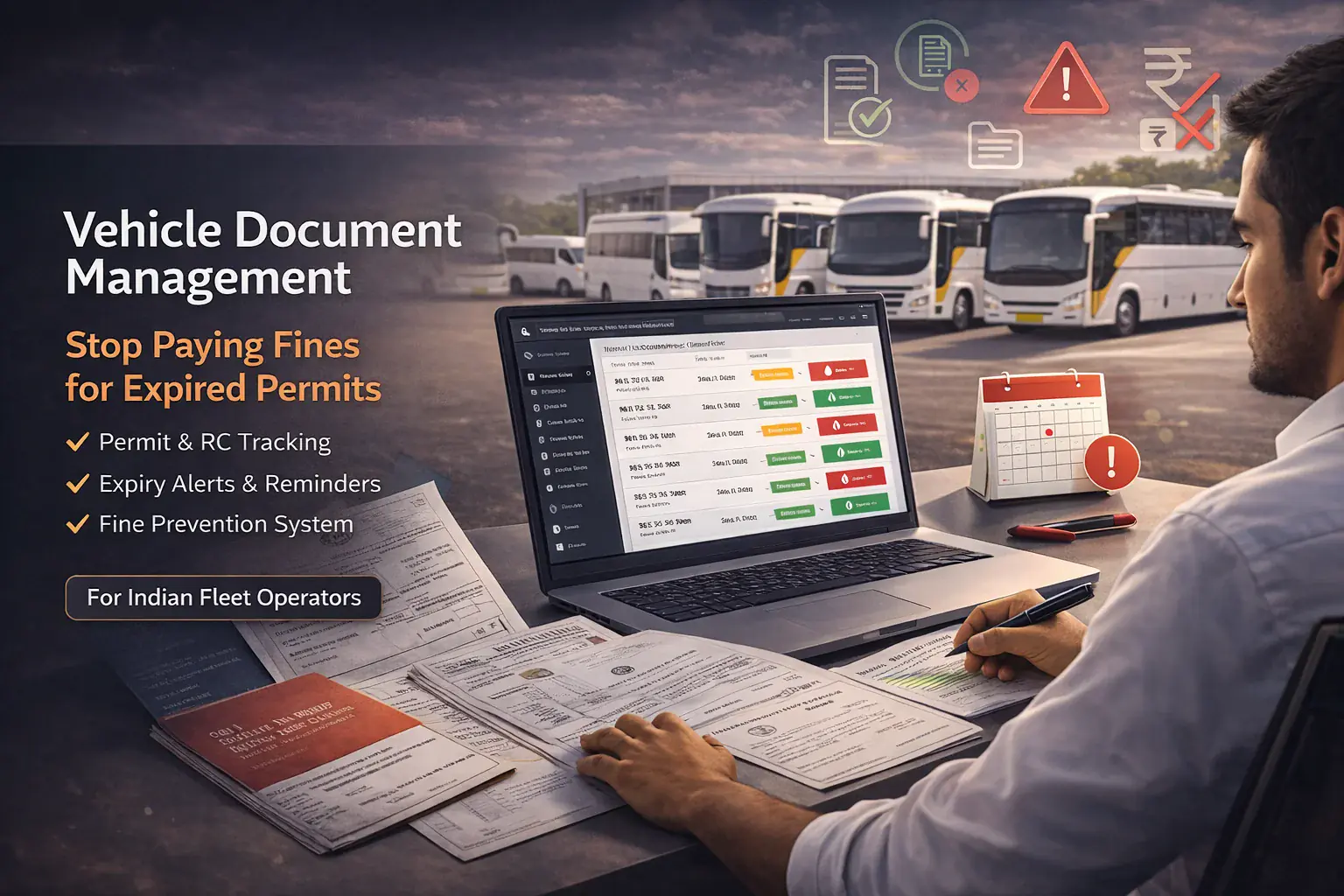
Vehicle document management India is one of the biggest challenges for fleet operators today. Ask any fleet operator what keeps them up at night, and document renewals will be near the top of the list. A single vehicle caught with an expired permit during tourist season — or worse, after an accident — can result in fines of ₹10,000 or more, vehicle seizure, and cancelled trips that cost far more than the fine itself.
Yet most operators still track these dates on paper registers or personal phone reminders. That's not a system. When the person who maintains those reminders leaves, the knowledge leaves with them.
This guide covers every document your fleet vehicles require under Indian law, why fleet compliance India has tightened since the Motor Vehicles (Amendment) Act 2019, and exactly how to set up a system that ensures nothing expires without 30 days of warning.
Quick Summary
- Track RC, Insurance, PUC, Fitness Certificate & Permits for every vehicle
- Set automated alerts 60, 30, 15, and 7 days before expiry
- Use fleet document tracking software instead of manual registers or spreadsheets
- Avoid fines up to ₹10,000 per violation under the Motor Vehicles (Amendment) Act 2019
Documents Every Fleet Vehicle in India Must Maintain
Under the Motor Vehicles Act and guidelines issued by the Ministry of Road Transport and Highways (MoRTH), every commercial vehicle in India must carry a specific set of valid documents at all times. For tour operators and travel businesses, the list is even longer because of tourist vehicle permits and state-specific requirements.
Vehicle document management India is not optional — it is a legal requirement with real financial consequences for non-compliance.
Effective fleet compliance management India requires proactive tracking of every document across vehicles and drivers.
Quick Answer: Commercial vehicles in India must maintain: RC Book, third-party insurance, fitness certificate, PUC certificate, national/state permit, and tourist vehicle permit. Each has a different renewal cycle — the fitness certificate every 1–2 years, PUC every 6–12 months, insurance annually. Missing any one of them can result in fines of ₹2,000–₹10,000 and vehicle detention.
Mandatory Vehicle Documents
- Registration Certificate (RC): Lifetime validity, but must be re-registered after 15 years for commercial vehicles
- Third-Party Insurance: Renewed annually — operating without valid insurance is a criminal offence under the Motor Vehicles Act
- Comprehensive Insurance: Optional but strongly recommended for fleet vehicles carrying passengers
- Fitness Certificate (FC): Required for commercial vehicles; typically valid for 1–2 years and issued after mandatory inspection at RTOs
- Pollution Under Control (PUC) Certificate: Renewed every 6 months (or annually for newer vehicles); checked at traffic stops
- National Permit / State Permit: Required for vehicles operating across state borders or within specific states
- Tourist Vehicle Permit: Specific permit required for vehicles carrying tourists — rules vary by state
Driver-Related Documents to Track
- Driving licence validity and endorsements
- Passenger badge (required in many states for tourist vehicle drivers)
- Medical fitness certificate (mandatory for commercial vehicle drivers)
The Real Cost of Non-Compliance
The Motor Vehicles (Amendment) Act 2019 significantly increased penalties for document violations. Here's what expired or missing documents can cost you:
- No insurance: ₹2,000 first offence, ₹4,000 repeat offence — plus potential criminal liability
- Expired fitness certificate: ₹5,000 fine and vehicle detention
- No valid permit: ₹10,000 fine and vehicle seizure in many states
- Expired PUC: PUC violations can attract fines up to ₹10,000 depending on enforcement and state regulations.
For fleets with 20+ vehicles, even a 5% document lapse rate can result in annual losses exceeding ₹1–2 lakh depending on fleet size and operations.
Insight: Fleet compliance failures are rarely due to cost — they are almost always due to missed tracking and lack of visibility.
Beyond the direct fines, the indirect costs are often higher — a vehicle detained mid-season means cancelled trips, refund demands, and reputational damage that takes much longer to recover from than a fine to pay.
Real-world example: A Manali-based operator running 15 Tempo Travellers during peak summer season had two vehicles detained at a Himachal Pradesh checkpost because their tourist vehicle permits had lapsed 11 days earlier. The lost revenue from those two vehicles over the weekend — two trips each — was ₹48,000. The permits cost ₹3,200 to renew. The problem wasn't cost; it was awareness.
How Most Operators Track Documents Today — And Why It Fails
The typical approach: a register at the office with renewal dates written by hand, or a shared Google Sheet that someone updates when they remember. A few operators use phone calendar reminders set by the operations manager.
These approaches fail at scale — and for growing fleets, the failure is not a matter of if but when.
These approaches fail because:
- They depend on a single person remembering to update and check them
- When that person leaves, the knowledge leaves with them
- They don't scale — at 5 vehicles it's manageable; at 25 vehicles it becomes a full-time job
- There's no audit trail — you can't prove when a document was updated or by whom
- Reminders get dismissed during busy periods and never revisited
- Vendor vehicle documents fall through the cracks entirely
Instead of relying on spreadsheets, many operators now use fleet document tracking software to automate renewals and avoid costly mistakes.
Operators who have switched to the best fleet management software in India consistently report that document compliance was one of the first — and most valuable — problems it solved for them.
What Digital Vehicle Document Management Looks Like
Centralised Vehicle Profile
Every vehicle in your fleet has a complete digital profile containing all documents with their expiry dates. The profile stores document details, the renewal date, and optionally a scanned copy of the physical document. Anyone on your operations team can pull up any vehicle's compliance status in seconds — from a phone, tablet, or laptop.
Automated Expiry Alerts
The system automatically calculates how many days remain for each document and sends alerts at defined intervals — typically 60 days, 30 days, 15 days, and 7 days before expiry. Alerts go to the operations manager, the fleet coordinator, and optionally the vehicle owner (for vendor vehicles). No manual checking required.
Renewal Tracking Workflow
When a renewal is due, the system creates a task with a responsible person assigned, a due date, and a status field. Once the renewal is completed, the new expiry date is updated and the document scan uploaded — creating a permanent, auditable renewal history for every vehicle in your fleet.
Fleet Compliance Dashboard
A single dashboard view shows the compliance status of your entire fleet: green (all documents valid), amber (renewal due within 30 days), and red (expired or expiring within 7 days). Operations managers see the full picture at a glance instead of checking vehicle by vehicle. For a 30-vehicle fleet, this replaces 30 separate checks with one dashboard view.
Tools like Track My Tour Fleet Management Software provide exactly this kind of fleet compliance dashboard — purpose-built for Indian tour operators managing both owned and vendor vehicles with state-specific permit requirements.
Managing Documents for Vendor Vehicles
Many Indian tour operators supplement their owned fleet with vendor-supplied vehicles. This adds a layer of complexity — you are responsible for verifying vendor vehicle compliance before assigning them to customer trips, but you don't control the renewal process.
Best practices for vendor vehicle compliance:
- Add vendor vehicles to your fleet management system with the vendor marked as owner
- Require vendors to upload document scans when onboarding
- Set automated alerts so you know when a vendor vehicle's documents are due — not just your own
- Include a document compliance clause in vendor contracts: non-compliant vehicles cannot be assigned trips
- Run a pre-trip compliance check as part of your trip assignment workflow
Special Considerations for Interstate Operations
Tour operators running vehicles across state lines face additional compliance complexity. National permits, inter-state tourist permits, and state-specific tax tokens all have different validity periods and renewal requirements — and the Ministry of Road Transport and Highways (MoRTH) has steadily tightened enforcement at state border checkposts.
According to guidelines from the Ministry of Road Transport and Highways (MoRTH), commercial vehicle compliance checks have become stricter across multiple Indian states.
Key points for interstate fleet compliance:
- National Permit (All India Tourist Permit) is required for tourist vehicles operating in more than one state
- Some states require an additional state entry permit or road tax payment — this varies by state and vehicle type
- Permit conditions often specify routes, vehicle types, and maximum passenger counts — violations attract heavy fines
- Vehicle permit renewal India timelines vary — start the process at least 30 days before expiry for interstate permits
Building a Renewal Calendar That Works
Whether you use dedicated fleet document tracking software or a structured spreadsheet, here's the minimum standard for a reliable renewal calendar. Operators who follow this approach — and review it weekly — virtually eliminate surprise document lapses.
- List every vehicle with its registration number and owner
- Add every document type with the current expiry date
- Set alerts at 60, 30, 15, and 7 days before each expiry
- Assign a responsible person for each renewal category
- Log the date of renewal and the new expiry date when completed
- Upload a scanned copy of each renewed document for audit purposes
- Review the compliance dashboard weekly — not just when alerts fire
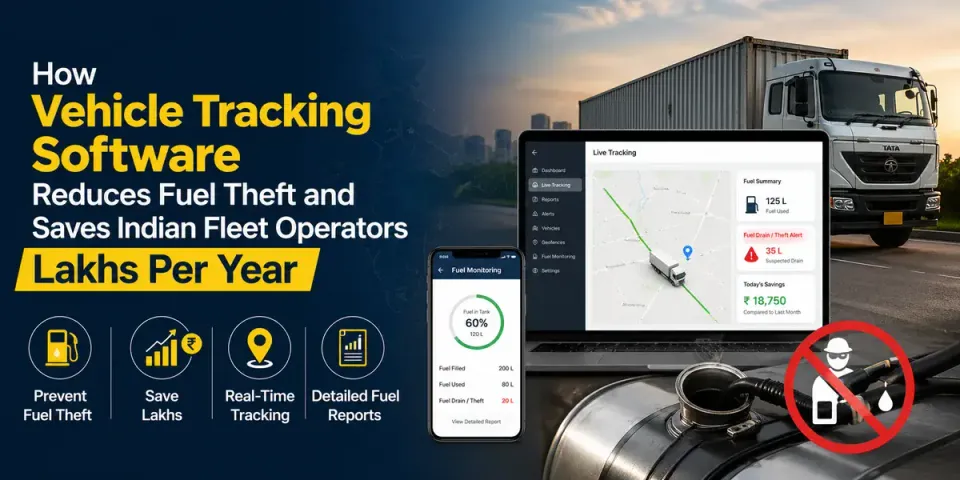
If you're also working on operational efficiency beyond compliance, see how operators are using software to vehicle tracking fuel savings alongside document management — the same platform handles both.
Frequently Asked Questions
What documents are required for tourist vehicles in India?
Tourist vehicles in India must carry: Registration Certificate (RC), valid third-party insurance, Fitness Certificate (FC), Pollution Under Control (PUC) certificate, and a Tourist Vehicle Permit issued by the relevant state RTO. Vehicles operating across state boundaries also need a National Permit (All India Tourist Permit). Driver-specific documents include a valid commercial driving licence with appropriate endorsement, passenger badge (in many states), and medical fitness certificate.
What is the fine for operating a vehicle with an expired fitness certificate in India?
Under the Motor Vehicles (Amendment) Act 2019, operating a commercial vehicle with an expired fitness certificate attracts a fine of ₹5,000 and vehicle detention until the certificate is renewed. Repeat violations carry higher penalties. The vehicle cannot be released until a valid FC is produced — which means a detained vehicle during peak tourist season can lose revenue worth many times the renewal cost.
How do I track vehicle document renewals for a large fleet?
For fleets of 10 or more vehicles, the only reliable method is dedicated fleet management software with automated expiry alerts. The system maintains a centralised vehicle profile for every vehicle, calculates days remaining for each document, and sends alerts at 60, 30, 15, and 7 days before expiry. A fleet compliance dashboard shows the status of all vehicles at a glance — green, amber, or red. Manual spreadsheets and phone reminders break down at scale. Track My Tour Fleet Management Software is purpose-built for Indian fleet operators with exactly this kind of compliance tracking built in.
How often does the PUC certificate need to be renewed in India?
The Pollution Under Control (PUC) certificate must be renewed every 6 months for petrol, diesel, and CNG vehicles older than 1 year. Newer vehicles (within the first year of registration) may have a longer initial validity. Fines for an expired PUC under the 2019 amendment are ₹10,000 — significantly higher than before. PUC checks are common at traffic stops, especially in metro cities and during pollution-related enforcement drives.
Can fleet software automatically alert me before vehicle documents expire?
Yes. Modern fleet management software tracks expiry dates for all documents across your entire fleet — insurance, fitness certificate, PUC, permits, and driver licences — and sends automatic alerts via app notification, SMS, or email at defined intervals before expiry. The alert goes to the operations manager and the responsible person for renewal. This significantly reduces the risk of missed renewals, regardless of staff turnover or how busy the season is.
Further Reading
- Best Fleet Management Software in India for Tour Operators (2026)
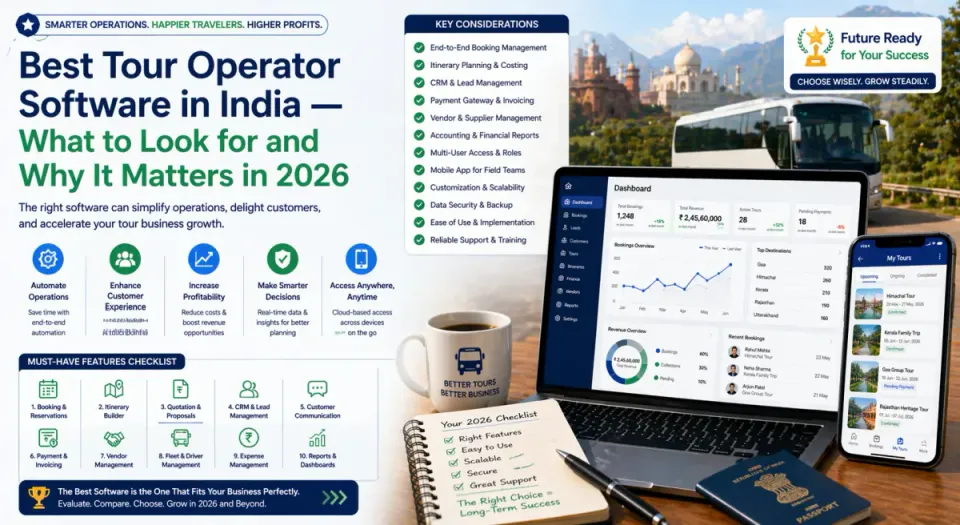
- Best Tour Operator Software in India — What to Look for
- How Vehicle Tracking Software Saves Indian Fleets Lakhs Per Year
Free Fleet Compliance Checklist
Want a ready-to-use checklist to track all your vehicle documents across your entire fleet? Download our free fleet compliance checklist covering RC, Insurance, PUC, Fitness Certificate, National Permit, Tourist Vehicle Permit, and driver documents — and never miss a renewal again.
- All mandatory documents listed by vehicle type
- Renewal frequency and lead time for each document
- Separate columns for owned vs. vendor vehicles
- Pre-trip compliance check template included
Never Miss a Renewal Again
Manage all your fleet documents in one place with Track My Tour Fleet Management Software — including automated expiry alerts, compliance dashboard, and renewal tracking for both owned and vendor vehicles.
Book a free demo and see how it works for your fleet.