Choosing fleet management software without a clear features checklist is one of the most expensive mistakes Indian tour operators make. Vendors lead with demos of impressive-looking dashboards, animated maps, and report galleries — leaving buyers to discover post-purchase that duty slip automation requires a separate module, the driver app doesn't work offline, or GST invoicing was clearly designed for a different market. The result: a ₹2–₹5 lakh annual subscription that your coordinators use for basic tracking only, while they continue doing everything else in WhatsApp and Excel.
This guide gives you a definitive fleet management software features checklist built specifically for Indian tour operators — the 10 capabilities to verify in every demo, the questions to ask to separate real functionality from demo-stage polish, and the red flags that indicate a platform will underperform in production.
What Makes Fleet Management Features Different for India
Most international fleet management platforms are built for logistics fleets on fixed routes. Indian tour operators operate fundamentally differently — dynamic itineraries, chauffeur-driven models, GST compliance requirements, state-specific permit rules, and driver workforces that include both employees and empanelled freelancers. A features checklist for logistics software gives you the wrong framework for evaluating tour-focused platforms.
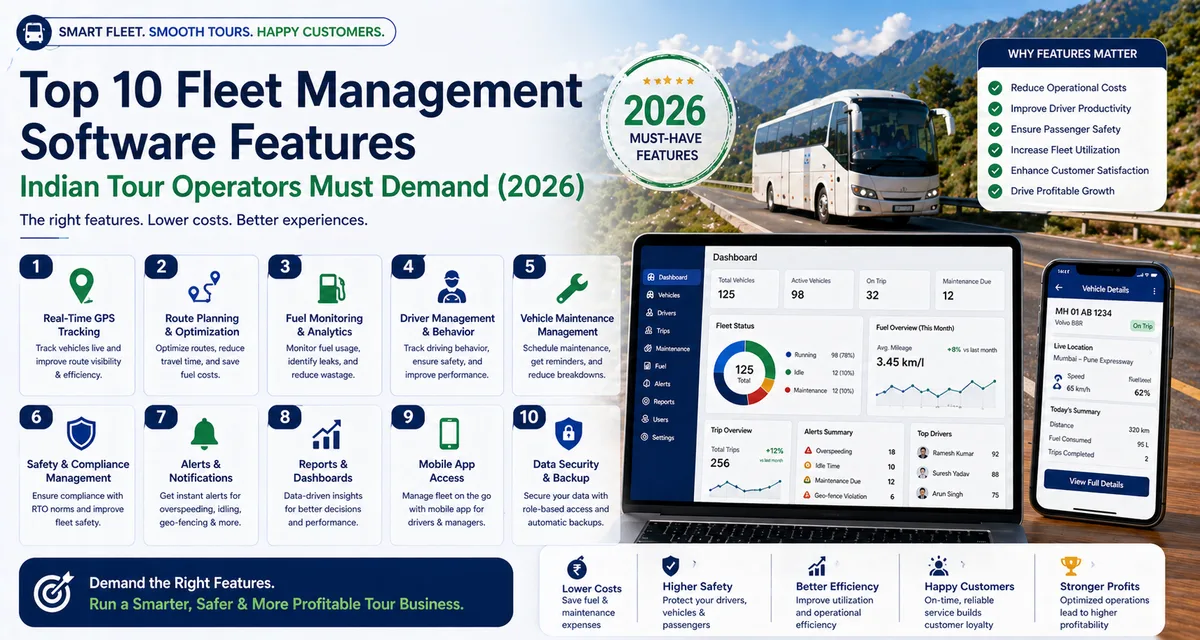
Quick Answer: The 10 must-have fleet management software features for Indian tour operators are: real-time GPS tracking, automated duty slip generation, vehicle and driver document management with expiry alerts, intelligent trip assignment, GST-compliant invoicing, fuel and expense monitoring with GPS cross-referencing, preventive maintenance scheduling, mobile driver app, customer-facing tracking links, and operational reporting with fleet-wide analytics. Every other feature is secondary to these working reliably and being designed for Indian operational context.
Feature 1: Real-Time GPS Tracking
Real-time GPS tracking is the most universally advertised fleet management software feature — and the most uneven in implementation quality. What separates reliable tracking from demo-stage tracking:
- Update frequency: Location should update every 15–30 seconds during active trips, not every 5 minutes.
- Accuracy: GPS data should be accurate to within 10–15 metres in urban areas — not 100–200 metres, which is useless for pickup coordination.
- Offline handling: GPS records must be stored locally on the driver's device and synced when connectivity returns — not lost when the vehicle enters a tunnel or a weak signal area.
- Trip history: Every completed trip must be fully replayable with timestamps, speed data, and stop records.
Test the tracking feature with a live driver during the demo — not just a simulated trip playback. See: How GPS Vehicle Tracking Works for Indian Fleet Owners.
Feature 2: Automated Duty Slip Generation
Automated duty slip generation is the highest-impact time-saving feature for Indian tour operators — and the one most frequently delivered poorly. True automation means: zero coordinator action required after a trip is logged, all required fields populated from booking and GPS data, and a PDF ready for download in under 5 seconds of trip completion. A platform that generates duty slips from a form the coordinator fills in manually has not automated duty slip generation — it has digitised it, which saves less than half the time.
Verify during the demo: end a trip and watch whether the duty slip appears without anyone clicking "generate." If the vendor needs to navigate to a separate screen and fill in any fields, ask why those fields weren't auto-populated from the trip record.
Feature 3: Vehicle and Driver Document Management
Every vehicle requires 5–8 active compliance documents; every driver requires 2–4. Across a 30-vehicle fleet, that's 300+ documents with independent renewal dates. Fleet management software must store all documents digitally against vehicle and driver profiles, and proactively alert operations managers 30 days before any expiry — without manual reminder setup. The system must also flag non-compliant vehicles as non-deployable until documents are updated, preventing accidental operation of vehicles with expired permits or insurance. See: Vehicle Document Management for Indian Fleets.
Test in the demo: set a document expiry date to tomorrow and verify that an alert appears and the vehicle is flagged in the dispatch view without any coordinator action.
Feature 4: Intelligent Trip Assignment
Assignment functionality must show vehicle availability (by type and location) and driver availability (by vehicle authorisation) simultaneously, prevent double-booking at the database level, and send automatic confirmation notifications to the assigned driver. The assignment workflow for a full day's worth of trips should be completable in under 20 minutes for a 30-vehicle fleet — not 90 minutes of cross-referencing calendars and phone calls. Smart conflict detection should surface problems proactively: vehicle due for maintenance during an assigned trip, driver already at capacity, vehicle type mismatch with booking requirements.
Feature 5: GST-Compliant Invoicing
GST invoicing for Indian transport services requires correct classification (SAC code 9964 for tour operator services), correct GST rate application (5% without ITC for most tour operators vs. 12% with ITC for certain transport categories), sequential invoice numbering, and PDF generation with all required fields for a valid tax invoice. The software must handle this automatically from trip data — not require your accounts team to manually apply rates. Test in the demo by completing a trip and requesting the generated invoice; verify the GST amount, HSN/SAC code, and all mandatory invoice fields are correctly populated.
Feature 6: Fuel and Expense Monitoring with GPS Cross-Referencing
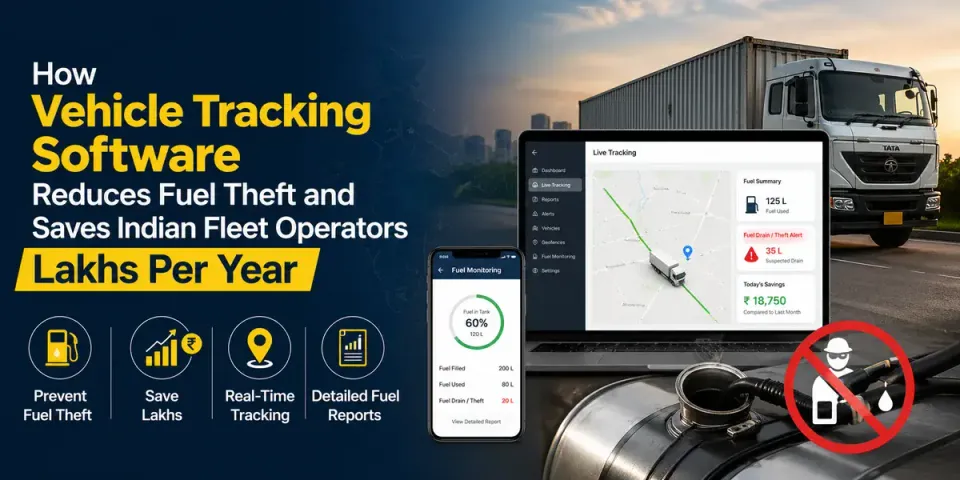
Fuel cost monitoring is only valuable when claims are automatically cross-referenced against GPS-verified trip distance. A platform that simply records driver fuel claims without verification is a data collection tool, not a cost control system. The cross-referencing must happen automatically — not through a report someone schedules. Driver expense submissions (fuel, tolls, parking) must flow through the driver app with receipt photos, be reviewable in the operations dashboard, and feed directly into payroll and billing calculations. See: How Vehicle Tracking Software Saves Indian Fleets Lakhs Per Year.
Feature 7: Preventive Maintenance Scheduling
Fleet management software must track service intervals by mileage (calculated from GPS odometer data) or calendar date and trigger maintenance alerts before the threshold is reached — not after the vehicle breaks down. Service records must be logged against the vehicle profile permanently, creating an auditable maintenance history for insurance claims, resale, and compliance purposes. A vehicle that hasn't had its service interval tracked is a vehicle with an unknown breakdown risk. Operators who implement preventive maintenance scheduling see unplanned repair costs drop by 25–35% within the first year.
Feature 8: Mobile Driver App
The driver app is not an optional add-on — it's the field interface that makes every other feature operational. The app must work on affordable Android handsets (₹8,000–₹15,000), handle offline mode gracefully, allow trip start/end with GPS timestamps, enable fuel and expense submission with receipt photos, display today's trip schedule clearly, and require no technical training beyond a 15-minute walkthrough. A driver app that works beautifully on an iPhone but frustrates drivers on affordable Android phones is not a production-ready driver app for Indian fleets.
Feature 9: Customer-Facing Tracking Links
When a vehicle departs for a pickup, the customer should automatically receive a link showing live vehicle location and estimated arrival — without the coordinator manually sending it. This feature is the most immediately visible product improvement your customers will experience after implementation. It reduces "where is my car?" inbound calls by 40–60%, and it fundamentally changes customer perception of your professionalism. Verify in the demo: complete a trip start and confirm that a tracking link is generated and sendable to a customer within 30 seconds, without coordinator intervention beyond the trip being marked started.
Feature 10: Operational Reporting and Analytics
Reports must be automatic, not manual. The platform should generate a daily operations summary automatically — trips completed, vehicles idle, fuel consumed, documents requiring action — and make it viewable without any coordinator data entry. Monthly reports should cover fleet utilisation rates, per-vehicle cost analysis, driver performance scores, and fuel efficiency trends. These analytics turn your operational data into decisions: which vehicles have the highest per-km cost, which drivers have the best safety scores, which routes are consistently unprofitable.
3 Questions to Ask in Every Fleet Software Demo
- "Show me a complete trip from booking to invoice — without any manual steps." Count every click, every form field, every coordinator action. The platform with the shortest path wins.
- "What happens when the driver's phone loses connectivity for 20 minutes?" Trip data should be stored locally and synced automatically on reconnection — not lost or requiring driver re-entry.
- "How are document expiry alerts triggered?" The answer should be "automatically, by the system, based on dates in the document registry." Not "you run an expiry report each week."
Frequently Asked Questions
What features must fleet management software have for Indian tour operators?
The non-negotiable features for Indian tour operators are: real-time GPS tracking with customer-shareable links, automated duty slip generation from trip data, vehicle and driver document management with proactive expiry alerts, intelligent trip assignment with double-booking prevention, GST-compliant invoice generation, GPS-verified fuel expense monitoring, preventive maintenance scheduling with mileage-based triggers, and a mobile driver app that works on affordable Android phones. Any platform missing these core features will require manual workarounds that reduce the efficiency gains of implementing software in the first place.
Are free fleet management tools sufficient for Indian tour operators?
Free fleet management tools — typically basic GPS tracking apps — cover location monitoring but lack duty slip generation, GST invoicing, document management, driver app functionality, and expense monitoring. For a tour operation running more than 5 vehicles with more than one coordinator, the time cost of the missing features (manual duty slips, manual document tracking, manual invoicing) exceeds the cost of a paid platform within 2–3 months. The right question is not "can I use a free tool?" but "what is the total cost of the manual work that a free tool forces me to continue doing?"
Should I choose cloud-based or installed fleet management software?
Cloud-based fleet management software is the correct choice for virtually all Indian tour operators in 2026. It offers access from any device (coordinators working from home, field managers on mobile, drivers on their phones), automatic updates, no IT infrastructure cost, and vendor-managed data backup. Installed (on-premise) software requires a server, IT maintenance, and manual updates — adding cost and complexity that cloud-based platforms eliminate entirely. The one exception is operators in areas with consistently unreliable internet — but even then, hybrid cloud platforms with offline modes are preferable to on-premise installations.
How many features does fleet management software need?
The right fleet management software has exactly the features your operation needs — no more. A 10-vehicle tour operator doesn't need enterprise-grade analytics or API integrations; they need automated duty slips, GPS tracking, document alerts, and GST invoicing to work reliably. More features add complexity and training time without adding operational value if your team doesn't use them. Evaluate on feature quality (does it work reliably?) and feature fit (does it match your actual workflow?) — not feature quantity.
Further Reading
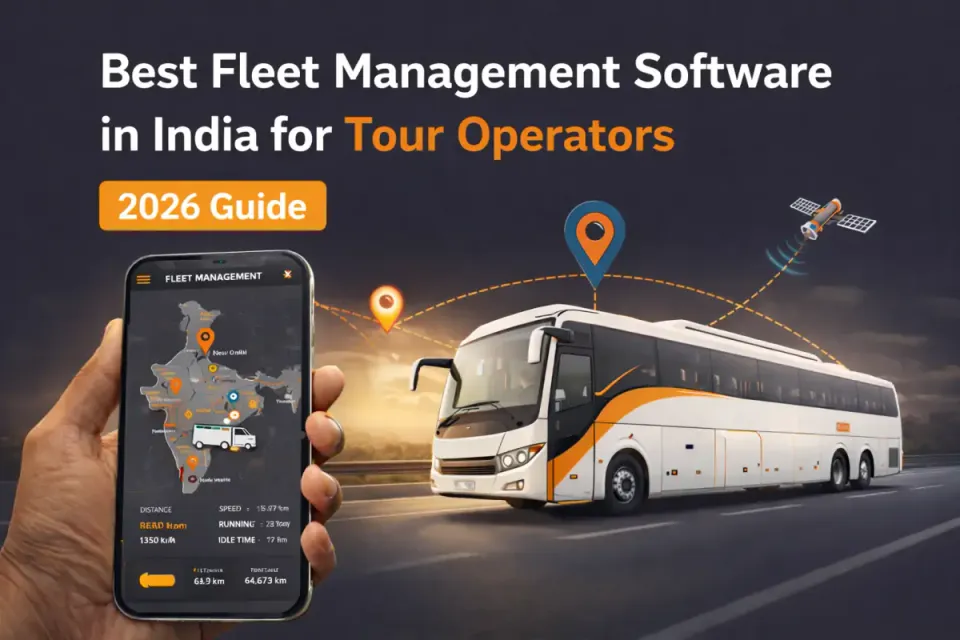
- Best Fleet Management Software in India for Tour Operators (2026)
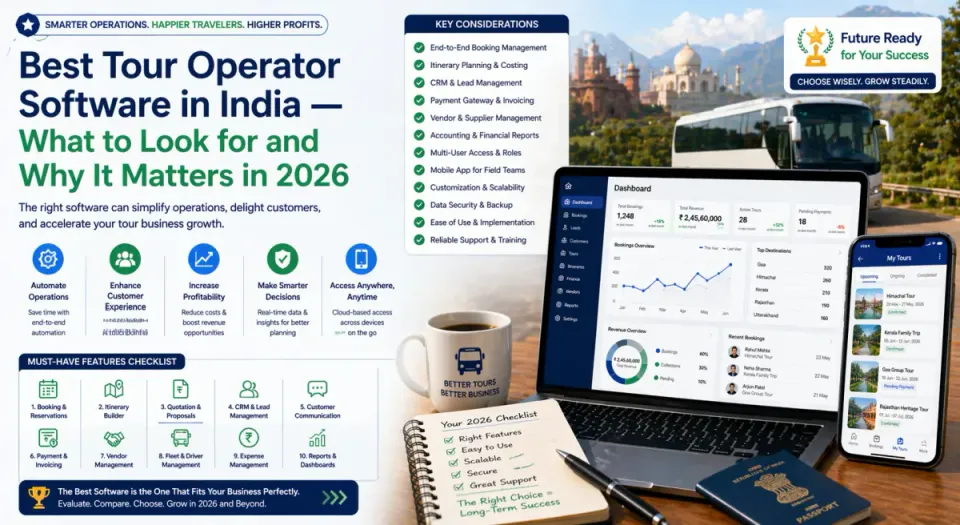
- Best Tour Operator Software in India — What to Look for in 2026
- Vehicle Document Management for Indian Fleets
- How Vehicle Tracking Software Saves Indian Fleets Lakhs Per Year
Get a Feature-by-Feature Demo
The only way to validate whether a fleet management platform has these features in production — not just in a demo — is to test each one yourself with a live driver and a real trip. Ask any vendor you're evaluating to walk through all 10 features in a live environment, not a screen recording.
Track My Tour includes all 10 must-have features, built for Indian tour operators from the ground up. Book a free 30-minute demo — we'll test every feature with your fleet size, your vehicle types, and a real trip from your current operation.