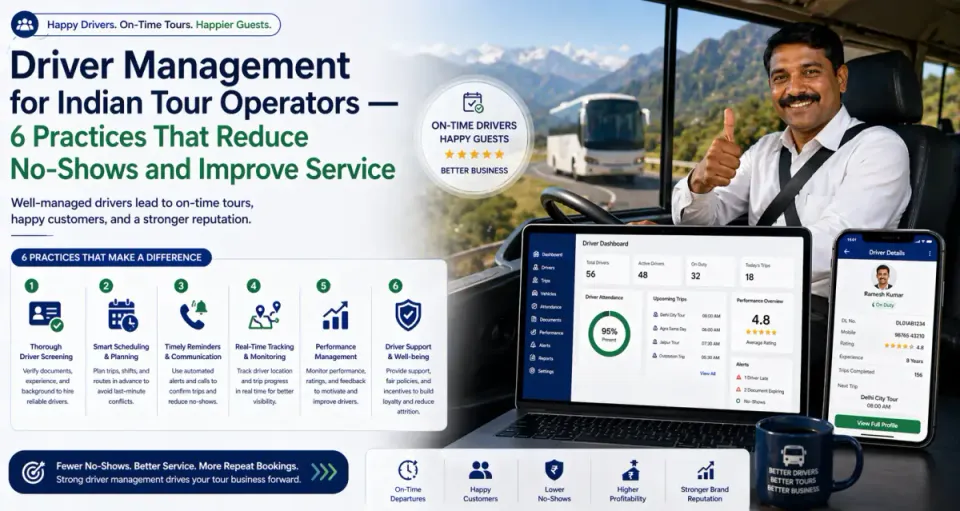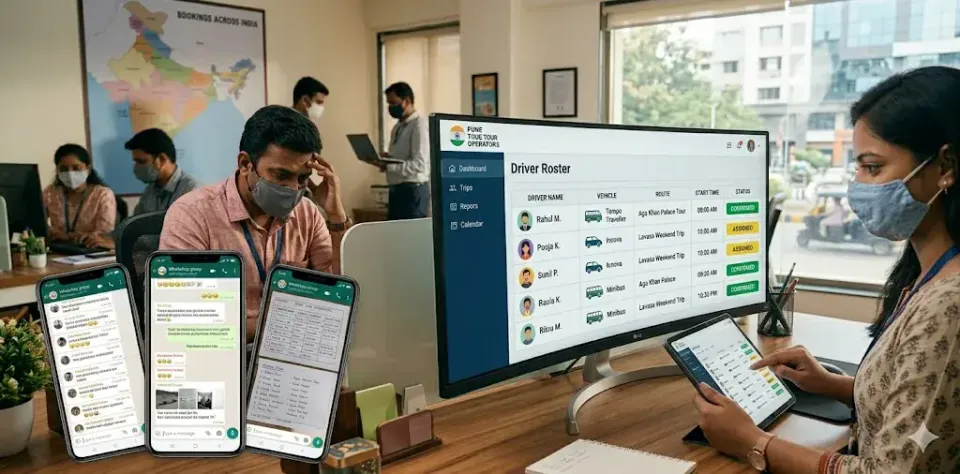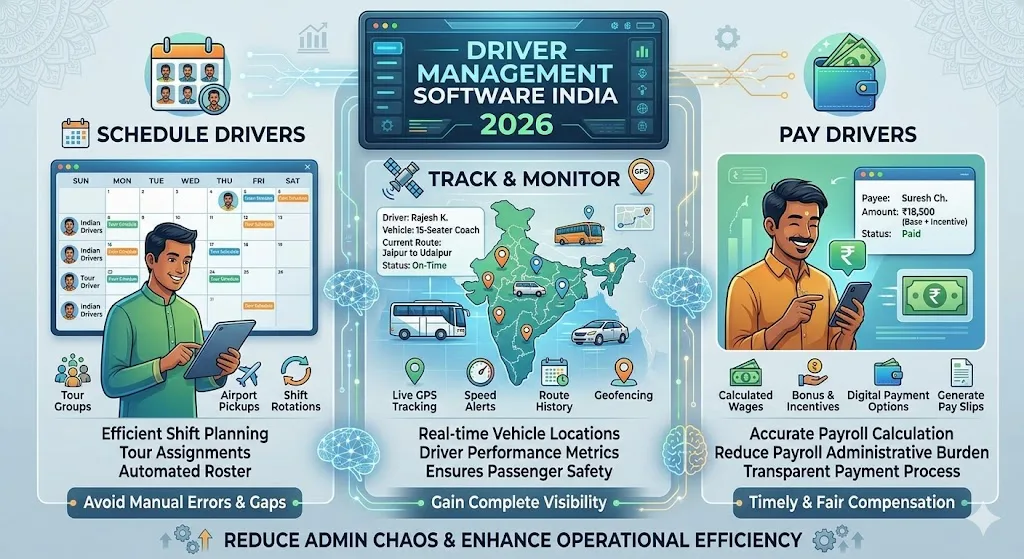
For Indian tour operators and fleet owners, drivers are the most critical variable in customer experience — and the hardest to manage at scale. When you have 5 drivers, WhatsApp and phone calls work fine. When you have 25, the cracks appear fast: drivers claim they didn't receive the trip message, two coordinators accidentally assign the same driver to different jobs, payroll reconciliation takes three days, and you have no reliable data on which drivers are performing well. Driver management software exists to solve exactly this — not with surveillance, but with structured systems that make professional behaviour the default.
This guide covers what driver management software actually does, the features Indian operators need beyond basic scheduling, how to evaluate platforms without being oversold on features you'll never use, and what implementation looks like for a 20–60 driver operation.
What Is Driver Management Software?
Driver management software is a platform that centralises every function related to managing a professional driver workforce: digital driver profiles, availability scheduling, trip assignment, mobile app-based trip execution, real-time location tracking, expense logging, performance monitoring, document expiry alerts, and payroll data generation.
Quick Answer: Driver management software replaces WhatsApp groups, spreadsheets, and phone-based coordination with a structured system where drivers receive trip assignments via app, confirm acceptance digitally, execute trips with GPS tracking active, log expenses with receipt photos, and complete trips with a digital trip record — all without coordinator intervention at each step.
For Indian tour operators specifically, driver management is inseparable from fleet management. A vehicle doesn't execute a trip on its own — driver assignment, driver confirmation, driver communication, and driver accountability are part of every operational workflow. Platforms that separate driver management from fleet operations force you to run two parallel systems and manually reconcile the data between them.
The 5 Problems Driver Management Software Solves
Problem 1: Driver No-Shows and Last-Minute Cancellations
A driver no-show at 5 AM for an airport transfer is the single most damaging operational failure in chauffeur-driven businesses — it results in a stranded passenger, a furious corporate client, and a review that stays on Google permanently. No-shows typically happen for one of three reasons: the driver didn't receive or see the trip assignment, the driver forgot amidst multiple verbal confirmations, or the driver had a personal conflict they didn't communicate. Driver management software addresses all three: assignments are delivered via push notification with mandatory acknowledgement, trip details are always visible in the driver's app, and drivers can flag availability issues days in advance rather than the night before.
Problem 2: Double-Assignment and Scheduling Conflicts
When two coordinators manage driver assignments separately — one handling corporate clients, another handling tour groups — double-assignment is inevitable. The same driver gets confirmed for two jobs at the same time, and neither coordinator knows until a client calls asking where their vehicle is. Driver management software maintains a single, real-time availability calendar for every driver. The moment a driver is assigned to a trip, they become unavailable in the system — visible to every coordinator simultaneously. Double-assignment becomes a technical impossibility, not a coordination challenge.
Problem 3: Expired Driver Licences and Badges
Operating a vehicle with an expired driving licence or an invalid passenger badge is a serious compliance risk in India — and it's entirely preventable. Under the Motor Vehicles (Amendment) Act 2019, licence violations can result in fines of ₹10,000 for the driver and licence suspension. For operators running tourist vehicles, state transport authorities can also suspend the operator's permit if repeated violations are detected. Driver management software maintains a complete document profile for every driver and alerts operations managers 30 days before any document expires. See: Vehicle Document Management for Indian Fleets.
Problem 4: Manual Payroll Reconciliation
Driver payroll in Indian tour operations is complex: base salary or per-trip fees, night allowances, waiting time charges, advance payments against future trips, fuel expense reimbursements, and deductions for damage or violations. Without a central system, payroll reconciliation requires pulling data from WhatsApp, paper logs, and call records — typically a 2–3 day process per pay cycle that's prone to errors in both directions (underpaying creates attrition; overpaying erodes margins). Driver management software auto-generates a payroll summary from trip records, logged expenses, allowances, and deductions — reducing the reconciliation process from days to hours.
Problem 5: No Data for Performance Management
Without data, performance conversations with drivers are entirely subjective. "You've been getting poor reviews" is harder to act on than "Your average Google review rating for trips in March was 3.8 vs. the fleet average of 4.6, and your harsh braking score was 2.1x the fleet average." Driver management software generates per-driver performance data from GPS behaviour scores, customer ratings, on-time arrival rates, and expense accuracy — giving managers a factual basis for recognition and improvement conversations. See: Driver Management for Indian Tour Operators: 6 Practices That Reduce No-Shows.
Key Features to Look for in Driver Management Software
1. Digital Driver Profiles
Every driver on your panel — full-time employees and empanelled freelancers — needs a complete digital profile: driving licence number and expiry, passenger badge number and expiry, vehicle type authorisations (sedan, tempo traveller, luxury coach), bank account details for payroll, emergency contact, and document photos. The profile should be searchable by licence type, vehicle authorisation, or availability — so a coordinator looking for an available heavy vehicle driver on a Tuesday morning can find one in 15 seconds.
2. Availability and Scheduling Calendar
The scheduling calendar must show every driver's status in real time: available, on trip, on leave, or off-duty. Drivers should be able to mark their own unavailability through the driver app — shift preferences, requested leave, and personal commitments — giving coordinators accurate data for planning without phone calls. Recurring shift patterns (drivers who always work morning or always work night) should be configurable to reduce daily scheduling load.
3. Trip Assignment and Confirmation Workflow
When a coordinator assigns a trip, the driver receives an instant push notification with all trip details: pickup location, drop location, passenger details, pickup time, vehicle assigned, and any special instructions. The driver acknowledges or declines in the app — with reasons for declines logged automatically. Unacknowledged assignments escalate to the coordinator after a configurable timeout, preventing silent no-shows. The entire confirmation chain is logged with timestamps for accountability.
4. Mobile Driver App
The driver app is where the entire field workflow lives. It must: show today's trip schedule, allow trip start and end with GPS timestamp, record fuel fill-ups with odometer and receipt photo, share live location during trips, enable customer communication (call or message through the app without exposing personal phone numbers), and generate trip completion records. Critically for Indian operations: the app must work on affordable Android phones (₹8,000–₹15,000 handsets) and have an interface simple enough for drivers with limited smartphone experience to use without training.
5. Driver Expense Management
Driver expense claims — fuel, tolls, parking, driver meals on long trips — must be submitted through the app with receipt photos and GPS-verified trip context. The system cross-references fuel claims against GPS mileage automatically, flagging discrepancies for review. Approved expenses flow directly into payroll calculations. This eliminates the manual expense form workflow, reduces processing time from days to minutes, and creates an auditable record for every claim. See: How Vehicle Tracking Software Saves Indian Fleets Lakhs Per Year.
6. Performance Monitoring and Reporting
Per-driver reports should cover: trips completed per period, on-time departure rate, average customer rating, GPS-derived driving behaviour score (speed violations, harsh braking, rapid acceleration), expense accuracy rate (claimed vs GPS-verified), and document compliance status. Monthly performance reports give managers the data needed for retention conversations and bonus decisions — replacing gut feel with objective, consistent metrics across your entire driver workforce.
Managing Employee Drivers vs. Empanelled Freelancers
Many Indian tour operators run a hybrid model: a core team of employed drivers plus a panel of freelance drivers activated during peak demand. Driver management software must handle both:
- Employee drivers: Fixed salary structure, leave entitlement tracking, provident fund and ESIC deductions, disciplinary records.
- Empanelled freelancers: Per-trip payment, minimum engagement thresholds, contract renewal tracking, GST-compliant payment receipts.
A platform that handles only one model forces you to manage the other in a separate system — undermining the efficiency gains of centralisation. Before selecting software, confirm explicitly how it handles empanelled/vendor drivers who aren't on your payroll.
Implementation for Indian Fleet Operators
Driver management software implementation for a 25–60 driver operation typically takes 5–7 days:
- Day 1: Import driver data — profiles, documents, vehicle authorisations.
- Day 2–3: Driver app installation sessions (group 10–15 drivers per session; walk through trip acceptance, start/end, expense logging).
- Day 4: Coordinator training on scheduling, assignment, and performance reporting dashboards.
- Day 5–7: Parallel run — new assignments go through the system; output validated against existing WhatsApp workflow.
- Day 7+: Full migration; retire WhatsApp-based dispatch for new trip assignments.
Frequently Asked Questions
What is driver management software?
Driver management software is a platform that centralises all functions related to managing a professional driver workforce: digital profiles, availability scheduling, trip assignment with app-based confirmation, real-time GPS tracking during trips, expense logging, document expiry alerts, performance monitoring, and payroll data generation. For Indian tour operators, it replaces WhatsApp-based coordination and manual scheduling with a structured, auditable system that scales reliably beyond 15–20 drivers.
How much does driver management software cost in India?
Driver management software in India is typically priced as part of a broader fleet management platform at ₹500–₹1,800 per vehicle per month — which includes driver app access, scheduling, expense management, and performance reporting. Standalone driver scheduling tools are available from ₹200–₹500 per driver per month, but they lack the integration with vehicle tracking and invoicing that creates operational efficiency. The best ROI comes from platforms where driver data flows directly into billing, compliance, and payroll without manual re-entry.
Does the driver app work without internet connectivity?
Good driver apps are designed to handle intermittent connectivity — common in hill stations, remote tour routes, and areas with poor 4G coverage. Trip records (start time, GPS track, expense logs) should be stored locally on the driver's phone and synced automatically when connectivity is restored. Confirm this capability explicitly during your software evaluation; not all platforms handle offline mode reliably, and data loss during poor connectivity periods undermines the entire record-keeping system.
Can driver management software handle empanelled freelance drivers, not just employees?
Yes — the best platforms for Indian tour operators support both employee drivers (salary structure, leave management, statutory deductions) and empanelled freelancers (per-trip payment, contract tracking, GST-compliant receipts). Confirm during your demo that the platform explicitly handles both models — many platforms assume all drivers are employees and require workarounds for freelance arrangements that break down at scale.
How does driver management software reduce driver no-shows?
Driver management software reduces no-shows through three mechanisms: mandatory digital acknowledgement of every trip assignment (unacknowledged assignments escalate automatically to the coordinator), always-visible trip schedules in the driver's app (eliminating "I forgot"), and advance availability management where drivers flag conflicts days in advance rather than hours before pickup. Operators implementing structured driver management typically see no-show rates fall from 5–8% to under 1% within the first 60 days.
Further Reading
- Driver Management for Indian Tour Operators: 6 Practices That Reduce No-Shows
- Driver Scheduling Software: Replace WhatsApp Groups with Automated Rosters
- Best Fleet Management Software in India for Tour Operators (2026)
- Vehicle Document Management for Indian Fleets
Build a Driver System That Runs Without You
The best driver management setups don't require the owner to intervene in daily dispatch. Drivers receive assignments, confirm them, execute trips, log expenses, and complete trips — with coordinators only stepping in when exceptions arise. That's what software enables: a self-running daily workflow with full visibility and accountability.
Track My Tour's driver management module is built specifically for Indian chauffeur-driven fleets. Book a free 30-minute demo and we'll walk you through the complete driver lifecycle — from scheduling to payroll — using your fleet size and driver structure.