For most Indian tour operators, drivers are the single most important variable in customer experience — and the hardest to manage consistently. A vehicle breakdown can be explained; a driver who doesn't show up for a 5 AM airport transfer cannot. That one no-show can cost you the customer, their referrals, and a scathing review.
Good driver management is not about surveillance or micromanagement. It's about creating systems that make professional behaviour the default — through clear communication, structured workflows, and data that replaces guesswork in performance conversations.
Here are six practices that Indian tour operators use to build reliable, professional driver teams.
Practice 1: Maintain Centralised Digital Driver Profiles
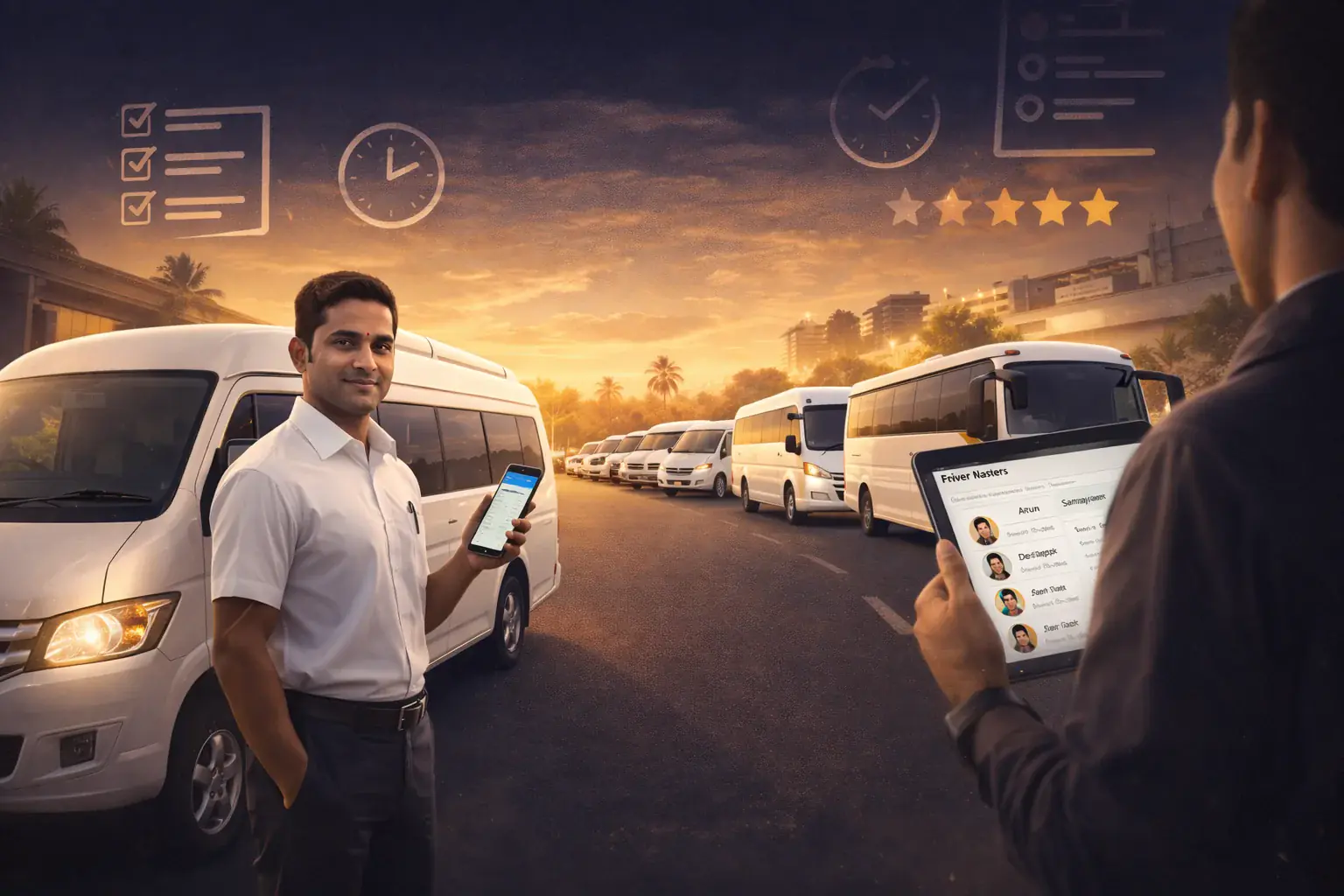
Every driver on your panel — whether a full-time employee or an empanelled freelancer — should have a complete digital profile that your operations team can access instantly. The profile should include:
- Driving licence number, category, and expiry date
- Passenger badge number and expiry (mandatory in many states for tourist vehicle drivers)
- Medical fitness certificate status
- Vehicle types the driver is qualified for (tempo traveller, sedan, luxury coach)
- Languages spoken — critical for tours serving international or regional domestic tourists
- Performance history: ratings, complaint records, and commendations
- Emergency contact details
When you receive a last-minute booking for a Hindi-speaking couple requiring a driver who can also serve as a guide in Rajasthan, you need to find the right match in 30 seconds — not spend 20 minutes calling around.
Quick Answer: Effective driver management for Indian tour operators relies on five pillars: centralised digital driver profiles, structured trip assignment with app-based confirmation, a real-time availability calendar, GPS tracking during duty hours, and a simple post-trip feedback system. Together, these systems reduce no-shows, improve service consistency, and eliminate last-minute scrambles.
Practice 2: Use Structured Trip Assignment With Confirmation
Assigning trips over WhatsApp with a simple "ok" reply is how most operators currently work — and it's how most no-shows happen. A driver who sees a WhatsApp message at 11 PM and taps "ok" while half-asleep may have no memory of the assignment by 4 AM.
A structured assignment workflow changes this entirely:
- Trip details are sent to the driver through the driver app with full information: pickup time, pickup location, customer name, customer phone number, drop location, and any special instructions
- The driver must explicitly confirm the assignment in the app — a tap-to-confirm, not a chat reply
- A reminder notification is sent to the driver 2 hours before the trip and again 30 minutes before
- If the driver does not confirm within a defined window, the system alerts the operations coordinator to follow up or reassign
This structure creates a clear record of who accepted what, and when — eliminating the "I didn't see the message" defence while giving drivers all the information they need to show up professionally.
Practice 3: Maintain a Driver Availability Calendar
One of the most common causes of last-minute driver scrambles is operators not knowing which drivers are already committed. When three trips are confirmed for the same morning and you start assigning, you discover your most reliable driver is already on a two-day outstation run.
A driver availability calendar — updated in real time as trips are assigned — prevents this entirely. Coordinators see driver availability at a glance before making assignments. Drivers can also mark themselves unavailable for planned leave, giving operators advance notice to arrange cover.
Real-world example: A Kochi-based operator managing 22 drivers across owned and vendor vehicles reduced last-minute driver scrambles from an average of 4 per week to less than 1 after implementing a shared driver availability calendar integrated with their trip assignment system. The change required no new hardware — just a shift from WhatsApp coordination to a structured app workflow.
Practice 4: Use GPS Tracking During Duty Hours
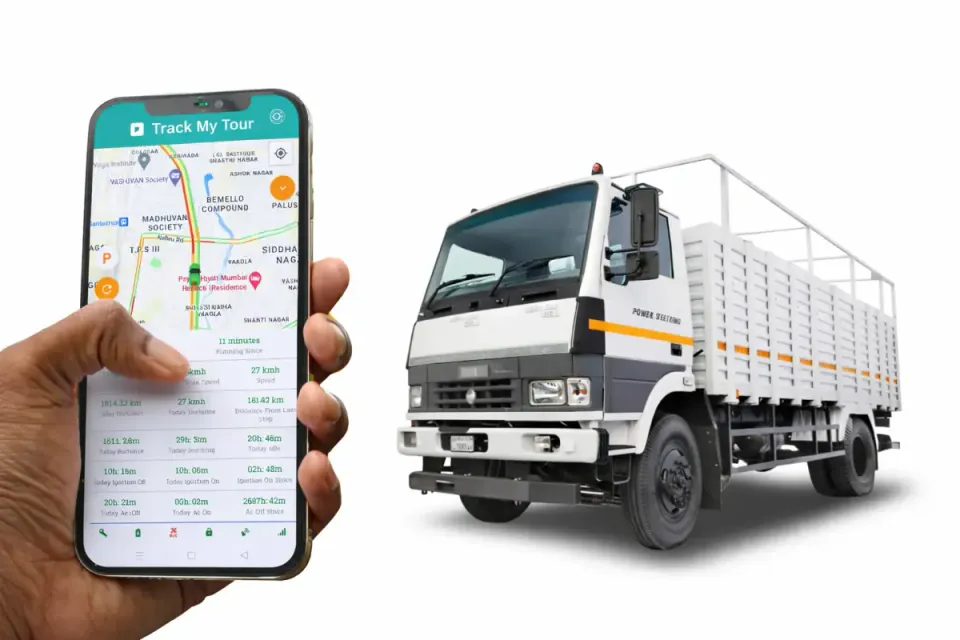
GPS tracking is often presented as a vehicle monitoring tool. For driver management, it's equally valuable as a communication tool. When a coordinator can see exactly where a driver is, the number of "where are you?" phone calls drops dramatically — and so does the stress for both parties.
GPS tracking during duty enables:
- Proactive customer communication: Share a live tracking link with the customer so they can see the vehicle approaching — no calls needed
- Route adherence monitoring: Significant deviations from the planned route trigger an alert, allowing coordinators to check in proactively
- Accurate duty slip generation: GPS-recorded start time, end time, and distance replace manual entries — reducing paperwork disputes
- Mileage verification: GPS distance cross-referenced against fuel claims catches discrepancies before they become habits
See: How GPS Vehicle Tracking Works for Indian Fleet Owners.
Practice 5: Create a Simple Driver Performance Feedback System
Most Indian tour operators have no structured way to capture customer feedback on driver performance. Positive feedback goes unacknowledged; complaints are handled reactively and inconsistently.
A simple feedback system changes the dynamic completely:
- After each trip, send the customer a one-click rating request (1–5 stars) via SMS or WhatsApp
- Record the rating against the driver's profile — not just the trip
- Review driver ratings monthly and share summaries with drivers
- Recognise consistently high-rated drivers — even a simple acknowledgement in a team meeting matters and builds loyalty
- Use data from consistently low-rated drivers to initiate coaching conversations with specific trip examples, not vague complaints
The goal is not to create a punitive ranking system — it's to make quality visible and give drivers actionable feedback they can act on.
Practice 6: Invest in Structured Driver Onboarding
Most driver onboarding in Indian tour operations consists of a brief conversation, a quick vehicle check, and a first trip assignment. Drivers are expected to figure out the rest. This is why the same mistakes repeat across new hires — because nobody documented what "good" looks like for your operation.
A structured onboarding covers:
- Company standards: Vehicle presentation before pickup, dress code, mobile phone use during trips, and how to handle customer complaints
- App training: How to use the driver app for trip confirmation, GPS tracking, and expense logging
- Customer communication protocols: When to call the customer, what to say if there's a delay, and when to escalate to the coordinator
- Fuel and expense logging: How to log fill-ups, what receipts to keep, and why accurate reporting matters
- Emergency procedures: What to do if the vehicle breaks down, if a passenger falls ill, or if there's an accident
A documented onboarding checklist takes 2–3 hours to complete with a new driver and pays back in fewer mistakes, fewer coordinator calls, and a more consistent customer experience from day one.
Managing Freelance and Empanelled Drivers
Many Indian tour operators work with a mix of full-time employed drivers and empanelled freelancers who are called in when demand exceeds capacity. Managing this mix requires additional practices:
- Maintain the same digital profile standards for freelancers as for full-time drivers
- Verify all documents before adding a driver to your panel — don't wait until the trip is confirmed
- Freelancers should go through the same app onboarding as full-time drivers; their GPS tracking and confirmation workflows must be identical
- Rate freelancers on the same feedback system — consistent quality standards apply regardless of employment type
Frequently Asked Questions
How do I reduce driver no-shows in my tour operation?
Driver no-shows are almost always caused by unclear communication — a WhatsApp "ok" that wasn't really acknowledged. Structured trip assignment through a driver app — with tap-to-confirm, full trip details, and automatic reminders 2 hours and 30 minutes before pickup — eliminates this. If a driver doesn't confirm within a defined window, the system alerts your coordinator to follow up or reassign. Most operators who implement structured assignment see no-shows drop by 70–80% within the first month.
What should a driver profile include for Indian tour operators?
A complete driver profile for Indian tour operations should include: driving licence number, category (LMV/HMV), and expiry date; passenger badge number and expiry; medical fitness certificate status; vehicle types qualified for; languages spoken; performance ratings history; complaint and commendation records; emergency contact details; and bank details for payment processing. This information should be accessible to your entire operations team, not stored on one person's phone.
How can GPS tracking help with driver management?
GPS tracking helps driver management in four ways: (1) it eliminates "where are you?" calls between coordinators and drivers; (2) it enables proactive customer communication via live tracking links; (3) it creates accurate, dispute-free duty slips from GPS-recorded trip data; (4) it cross-references mileage against fuel claims, preventing inflated expense reporting. For most tour operators, app-based GPS tracking deploys fleet-wide in one day with zero hardware cost.
What is the best way to get customer feedback on driver performance?
The most effective method for Indian tour operators is a one-click post-trip rating request sent via WhatsApp or SMS immediately after the trip ends — while the experience is fresh. The rating links to the driver's profile, not just the trip record, building a performance history over time. Monthly driver summaries shared with your team create accountability without requiring confrontation. High-rated drivers should be recognised explicitly — it costs nothing and significantly improves retention.
How do I manage freelance drivers alongside full-time staff?
Freelance and empanelled drivers should be held to exactly the same standards as full-time staff: complete digital profiles, verified documents, app onboarding, structured trip assignment with confirmation, GPS tracking during duty hours, and post-trip customer ratings. The only operational difference is the employment type — the quality and workflow standards must be identical. Operators who maintain separate, lower standards for freelancers consistently experience higher no-show rates and customer complaints from freelance trips.
Further Reading
- Best Fleet Management Software in India for Tour Operators (2026)
- Best Tour Operator Software in India — What to Look for
- How GPS Vehicle Tracking Works for Indian Fleet Owners
Build a Driver Team That Runs Itself
The difference between a tour operation that scales smoothly and one that hits a ceiling at 15–20 vehicles is almost always systems — not the quality of the drivers. Most drivers want to do their job well; they just need clear expectations, reliable information, and timely feedback.
Track My Tour's driver management module includes digital driver profiles, structured trip assignment with confirmation, GPS tracking, and performance reporting — built specifically for Indian tour operators. Book a free demo to see how it works with your current team structure.