Every car rental operator in India reaches a point where WhatsApp bookings, paper registers, and phone-based dispatch stop working. For most, that moment arrives around 10–15 vehicles — when a single coordinator can no longer track availability, confirm bookings, manage drivers, and generate invoices without something slipping through. Car rental management software exists to solve exactly this problem, and choosing the right one in India means looking past international platforms that weren't built for Indian compliance, GST, and permit requirements.
This guide covers what car rental management software actually does, the 7 features Indian operators cannot compromise on, how to evaluate pricing without getting locked into bad contracts, and what a realistic implementation looks like for a 20–50 vehicle fleet.
What Is Car Rental Management Software?
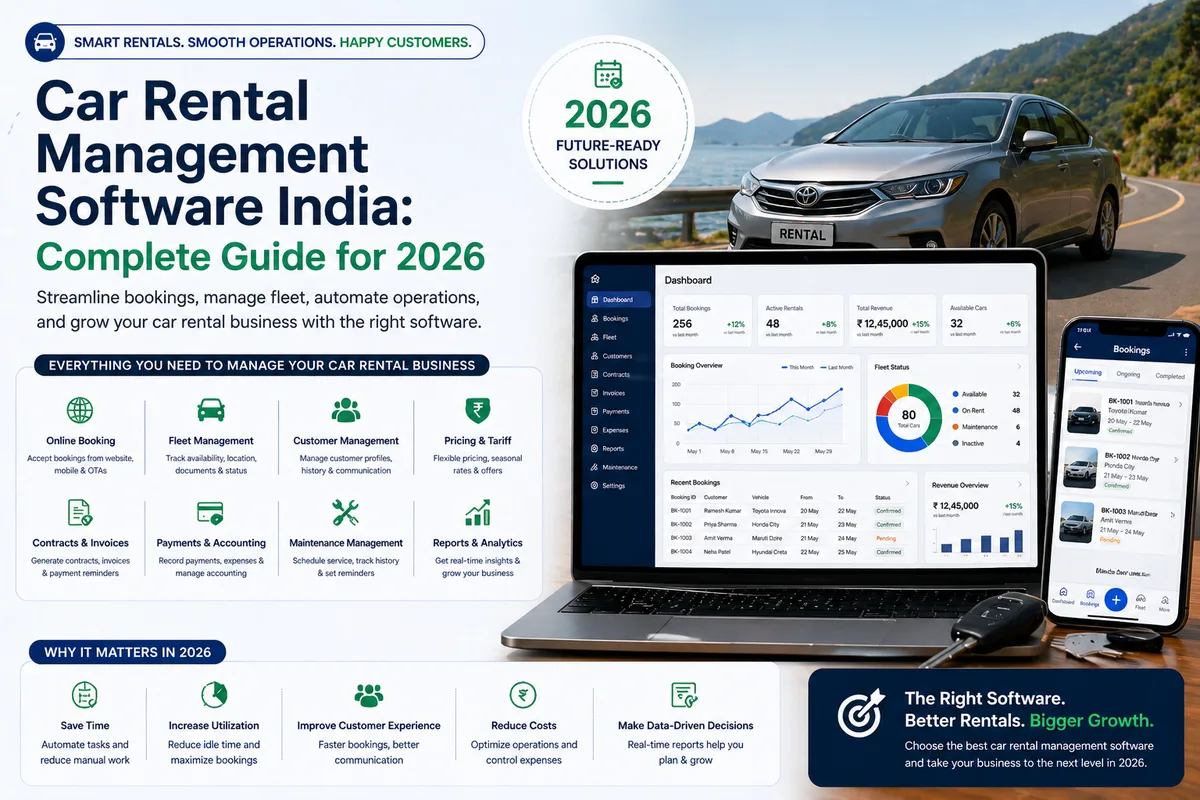
Car rental management software is a centralised platform that handles every operational function of running a vehicle rental business: bookings, vehicle availability, driver assignment, real-time GPS tracking, customer communication, GST-compliant invoicing, document compliance, and expense tracking — all from one interface accessible on any device.
Quick Answer: Car rental management software replaces the combination of WhatsApp groups, spreadsheets, and paper registers that most Indian operators use. It automates booking confirmation, vehicle availability checks, driver assignment, duty slip generation, GPS tracking, and GST billing — reducing manual admin time by 60–70% and eliminating the double-booking and compliance risks that come with unstructured systems.
For Indian operators, the platform must do one thing that international car rental software rarely handles well: conform to Indian compliance requirements. This means permit management, tourist vehicle regulations, GST on transport services, and state-specific document rules — all of which are non-negotiable in the Indian market.
Why Generic Software Fails Indian Car Rental Operators
Most internationally developed car rental platforms are built for self-drive markets in the US or Europe, where the model is: customer books online, picks up vehicle, returns it, pays by credit card. Indian car rental operations are fundamentally different:
- Chauffeur-driven is the dominant model: Most Indian car rentals include a driver, adding an entire layer of scheduling, duty slips, driver payments, and driver app requirements that self-drive software ignores.
- GST complexity: Indian transport services have specific GST rates (5% with ITC restrictions vs. 12% with full ITC), and the software must handle both correctly on invoices.
- Corporate billing: Indian enterprises typically require purchase-order-based invoicing, monthly statements, and integration with their accounts payable systems — not real-time card charges.
- Permit and compliance tracking: Every vehicle requires valid insurance, fitness certificates, pollution certificates, and state-specific tourist vehicle permits. Missing one means fines and detention.
- Cash and partial payment: Indian clients often pay part in advance, part on completion. Software must handle split payments, balance dues, and driver cash collections.
Generic platforms address none of this. Indian operators who implement them typically spend months trying to customise a workflow that doesn't fit — and abandon the software at cost.
7 Features Your Car Rental Management Software Must Have
1. Vehicle Availability and Booking Calendar
The foundation of any car rental software is a real-time availability view. Every confirmed booking must block the vehicle from the calendar instantly — visible to every coordinator simultaneously. The system should prevent double-booking at the database level, not rely on staff coordination. The calendar must show vehicle type, capacity, current location, and next scheduled maintenance in a single view. A coordinator confirming a tomorrow-morning booking at 10 PM should know in five seconds whether the vehicle is available, where it's currently located, and whether it's due for service this week.
2. Booking and Reservation Management
Bookings arrive through multiple channels — phone calls, WhatsApp, email, direct website inquiries, and corporate portals. All of them must land in one queue. Car rental software should let coordinators create bookings in under two minutes, attach the correct vehicle and driver, generate a booking confirmation, and send it to the customer automatically. Any change to the booking should reflect across the vehicle calendar, driver schedule, and customer communication chain without additional manual steps.
3. Real-Time GPS Tracking
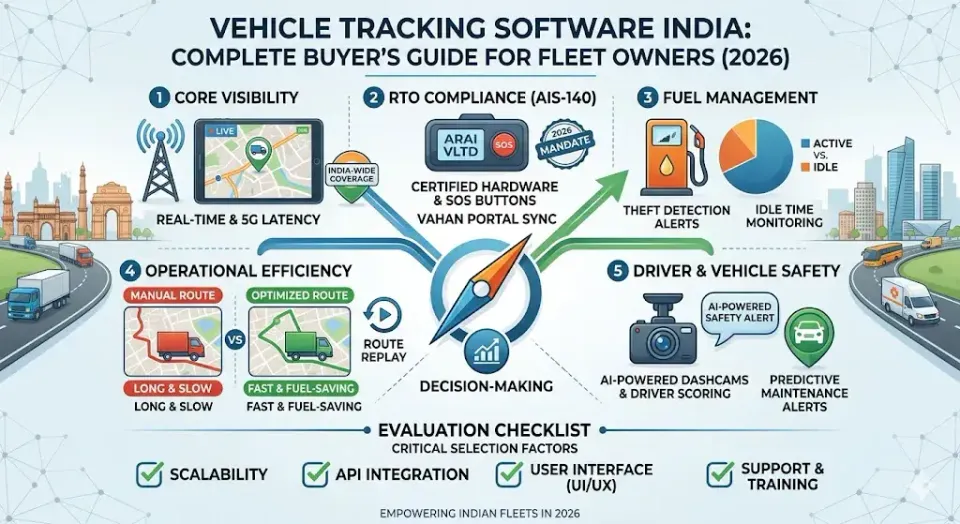
Live vehicle location serves multiple stakeholders simultaneously. Operations coordinators use it to answer "where is the vehicle?" without calling the driver. Customers use a shared live tracking link to monitor arrival, exactly like tracking a Swiggy delivery. Fleet managers use trip history to verify routes and resolve disputes. App-based GPS tracking — using the driver's existing Android phone — eliminates the ₹3,000–₹8,000 per-vehicle hardware cost of standalone GPS devices while providing the same real-time accuracy. See: How GPS Vehicle Tracking Works for Indian Fleet Owners.
4. Driver Assignment and Scheduling
Every chauffeur-driven booking requires a driver assignment — and managing this manually across 20+ vehicles and 25+ drivers is where most car rental operations collapse. Software must show driver availability in real time, prevent double-assignment, send automatic trip confirmations to drivers via the app, and let drivers confirm, start, and end trips from their phone. A well-designed driver app works on affordable Android handsets without requiring technical training — your average driver should be operational within 15 minutes of installation.
5. GST-Compliant Billing and Invoicing
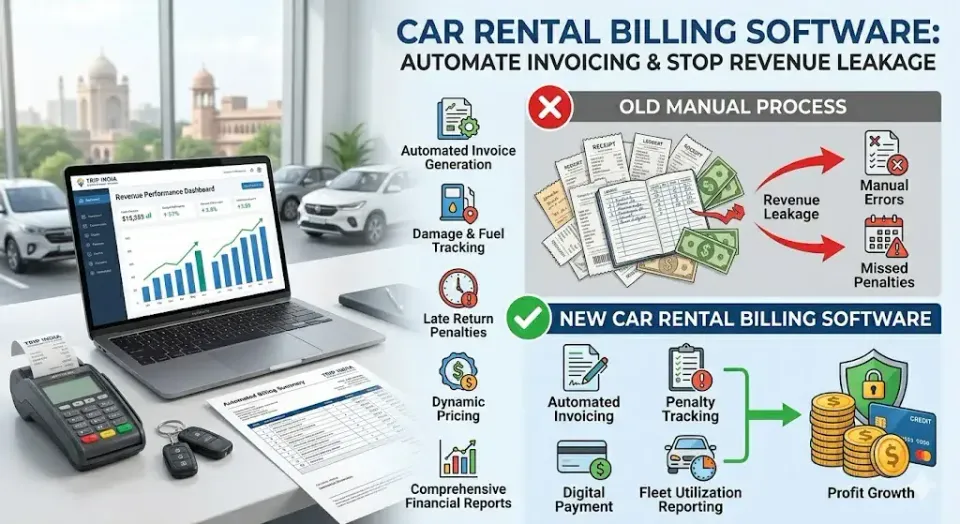
Manual GST invoice creation is the single biggest source of billing delays in Indian car rental businesses. Every trip should auto-generate an invoice with the correct GST rate, vehicle details, trip distance, driver details, and company information — ready for download as a PDF the moment the trip ends. For corporate clients, the software should support PO-based invoicing, monthly consolidated statements, and email delivery. Delayed invoicing means delayed payment; operators who automate billing report cutting their average payment cycle from 12 days to 4 days.
6. Vehicle Document and Compliance Tracking
Every vehicle in your fleet requires: insurance policy, motor vehicle fitness certificate, pollution under control certificate, tourist vehicle permit (state-specific), and commercial vehicle registration. Under the Motor Vehicles (Amendment) Act 2019, an expired fitness certificate alone carries a ₹5,000 fine plus vehicle detention. Your software must maintain a complete document profile for every vehicle and alert you 30 days before any document expires — automatically, without manual tracking. See: Vehicle Document Management for Indian Fleets.
7. Expense and Fuel Monitoring
Fuel is typically 30–40% of car rental operating costs. Driver fuel expense claims without GPS verification are an open door to leakage. Car rental software must let drivers submit fill-ups with the odometer reading and a receipt photo, then automatically cross-reference the claimed amount against GPS-recorded trip distance. Discrepancies are flagged for review — eliminating the confrontation of manual auditing while making inflated claims visible. Operators who implement GPS-verified expense logging typically see fuel cost reductions of 12–18% within the first 90 days. See: How Vehicle Tracking Software Saves Indian Fleets Lakhs Per Year.
Corporate Car Rental vs. Retail: Different Software Requirements
Corporate car rental management has distinct requirements that differ from retail (walk-in or app-based) car rental:
- Corporate: Requires PO-based invoicing, approved vendor rate cards, monthly billing, employee-authorised booking systems, cost-centre allocation, and formal account management workflows.
- Retail: Requires faster booking confirmation, customer-facing online booking, real-time payment processing, and dynamic pricing flexibility.
Most Indian car rental software handles one or the other well. If you serve both corporate and retail clients, look specifically for platforms that handle both billing models simultaneously — this is where many operators end up running two parallel systems unnecessarily.
How Car Rental Software Eliminates Revenue Leakage
Revenue leakage in car rental businesses typically comes from four sources: undercharged trips (where the actual distance wasn't billed), unbilled extras (waiting charges, night charges, toll reimbursements), delayed invoicing that discounts cash flow, and fuel expense fraud. Well-implemented car rental software addresses all four:
- GPS-verified distance is used to auto-populate billing, preventing undercharging.
- Trip extras (waiting time, night halts, tolls) are logged in the driver app and added automatically to the invoice.
- Auto-invoicing at trip end means the invoice is ready within minutes, not days.
- GPS-matched expense logs make fuel fraud visible before it compounds.
A mid-sized car rental operator with 30 vehicles can realistically recover ₹1.5–₹3 lakh per month in previously untracked revenue leakage within the first two months of implementing structured billing.
Pricing to Expect in India (2026)
Car rental management software in India is typically priced per vehicle per month, ranging from ₹400 to ₹1,800 depending on feature depth. Watch out for these red flags:
- Hardware requirements: Software that mandates GPS hardware adds ₹3,000–₹8,000 per vehicle upfront. App-based GPS eliminates this.
- Per-user pricing: If pricing is per user (not per vehicle), costs escalate quickly as your team grows.
- Annual lock-in before demo: Any vendor requiring annual commitment before you've run a pilot is either desperate for cash flow or knows their churn numbers are bad.
- Support charges: Implementation and onboarding should be included, not charged separately.
What a Realistic Implementation Looks Like
A cloud-based car rental management software for a 20–40 vehicle operation can go live in 5–10 business days:
- Day 1–2: Import vehicle and driver data; configure GST and billing settings.
- Day 3–4: Install driver app on all driver phones; run one test trip end-to-end.
- Day 5–6: Train coordinators on booking and dispatch workflows (typically a 3-hour session).
- Day 7–10: Run parallel operations — new bookings go through software, output compared against old workflow for validation.
- Day 10+: Full migration; decommission WhatsApp-based dispatch.
Frequently Asked Questions
What is car rental management software?
Car rental management software is a cloud-based platform that centralises all operational functions of a vehicle rental business: vehicle availability, booking management, driver scheduling, real-time GPS tracking, customer communication, GST-compliant invoicing, and document compliance tracking. It replaces the combination of WhatsApp, spreadsheets, and paper registers that most Indian car rental operators use, eliminating double bookings, missed renewals, and billing delays.
How much does car rental management software cost in India?
Car rental management software in India is typically priced between ₹400 and ₹1,800 per vehicle per month, depending on features. App-based platforms that use the driver's existing smartphone for GPS eliminate the ₹3,000–₹8,000 per-vehicle hardware cost associated with dedicated GPS devices. Avoid platforms that require annual commitment before a pilot, charge separately for support, or price per user instead of per vehicle.
Can car rental software handle both self-drive and chauffeur-driven fleets?
Most car rental software handles one model well. For chauffeur-driven operations (the dominant model in India), look specifically for platforms with robust driver app functionality, duty slip generation, driver scheduling, and driver expense logging. For self-drive, the priority shifts to online booking, customer ID verification, and return-condition logging. If you run both, ensure the platform explicitly supports both billing and operational models before committing.
How long does implementation take for a car rental business?
A cloud-based car rental management platform for a 20–40 vehicle fleet typically goes live in 5–10 business days. This includes vehicle and driver data import, driver app installation, coordinator training, and a parallel validation period. No IT infrastructure is required for cloud-based platforms. The main variable is driver onboarding — how quickly your drivers install the app and complete a test trip determines whether you're at day 5 or day 10.
What is the difference between car rental software and fleet management software?
Car rental management software is built for customer-facing rental operations: booking management, availability calendars, customer invoicing, and per-rental cost tracking. Fleet management software is broader — it covers vehicle maintenance, document compliance, fuel monitoring, and operational analytics for any fleet type, including owned fleets that aren't rented out to customers. The best platforms for Indian car rental operators combine both: a rental-focused booking and billing workflow built on top of a full fleet management foundation.
Further Reading
- Best Fleet Management Software in India for Tour Operators (2026)
- Vehicle Tracking Software India: Complete Buyer's Guide
- Vehicle Document Management for Indian Fleets
- How Vehicle Tracking Software Saves Indian Fleets Lakhs Per Year
See Car Rental Management in Action
The fastest way to evaluate any car rental management software is a live demo using your actual fleet size, vehicle types, and a sample booking. Ask the vendor to walk you through the complete workflow: booking creation → driver assignment → GPS tracking → trip completion → GST invoice generation. That 30-minute demo will tell you more than any feature matrix.
Track My Tour is built for Indian operators running chauffeur-driven fleets and tour operations. Book a free 30-minute demo and we'll show you exactly how it maps to your current booking and dispatch workflow.