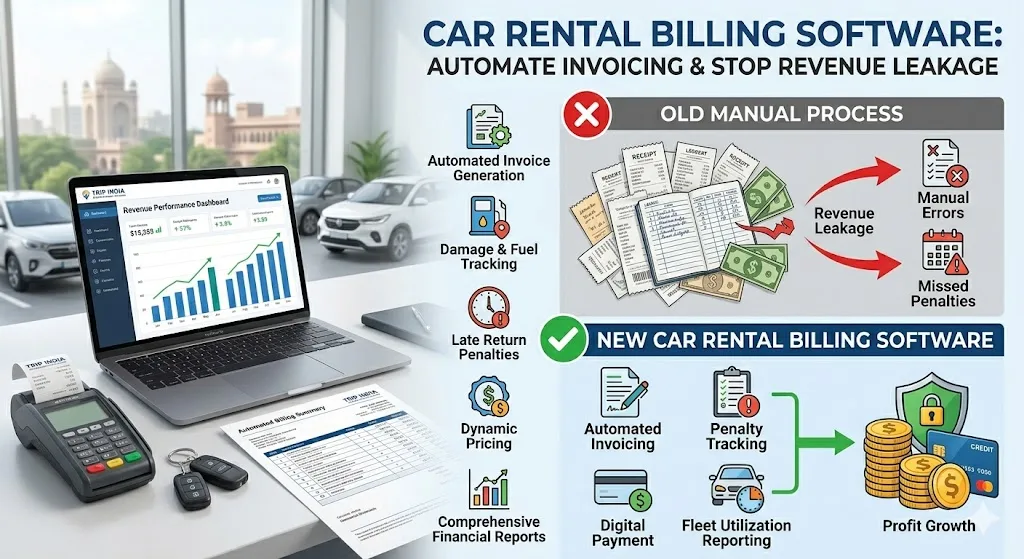
Revenue leakage in car rental billing is one of the most expensive and least visible problems in Indian ground transport businesses. Every trip that ends without a correctly itemised invoice — one that captures the actual distance driven, waiting time accumulated, tolls paid, and night halt charges incurred — is a trip where money was left on the table. Multiply that by 30 vehicles running 2–3 trips each per day, and manual billing errors compound into lakhs of annual revenue loss without any obvious single incident to point to. Car rental billing software automates the entire invoice workflow — from trip completion to payment collection — eliminating the errors, delays, and revenue leakage that manual billing creates.
This guide covers what car rental billing software does, the revenue leakage patterns it addresses, the specific Indian compliance requirements it must handle, and what to look for in a billing solution built for Indian car rental operations.
What Is Car Rental Billing Software?
Car rental billing software is a platform that automatically generates accurate, GST-compliant invoices from trip data — capturing GPS-verified distance, trip duration, driver charges, extras (waiting time, tolls, night halt), and applicable tax rates — and delivers them to clients digitally at trip completion or on a configured billing cycle.
Quick Answer: Car rental billing software eliminates manual invoice creation by auto-generating GST-compliant bills from verified trip data the moment each trip ends. For Indian operators, it handles the full billing workflow: correct GST rates for transport services, PO-based corporate invoicing, driver trip extras, digital invoice delivery, payment tracking, and monthly consolidated statements — all without coordinator data entry after the trip is logged.
For Indian car rental businesses, billing software must do more than generate invoices. It must handle Indian GST compliance correctly (the wrong rate applied to transport services creates liability), support corporate PO-based invoicing workflows (the dominant model for B2B car rental in India), and integrate with vehicle tracking so GPS-verified distance is used for billing rather than driver-submitted odometer readings.
6 Revenue Leakage Patterns That Billing Software Eliminates
1. Unbilled Waiting Time and Trip Extras
In most manual billing workflows, extras — waiting time at the airport, additional stops, night halt charges when the driver stays away from base — are billed only if the coordinator remembers to include them. Driver-submitted reports are inconsistent; clients don't volunteer to pay for extras they weren't explicitly invoiced for; and coordinators managing 40+ trips per week can't track every extra across every trip in their memory. Billing software captures trip extras in real time through the driver app: the driver logs waiting time as it accumulates, records tolls at payment, and marks night halts at trip end. Every extra flows automatically into the invoice — nothing requires coordinator recall.
2. Distance Undercharging
When billing is based on driver-submitted odometer readings rather than GPS-verified distance, two problems emerge: drivers occasionally under-report (for reasons that don't serve your billing interests) and coordinators round down to convenient numbers. On a ₹18/km rate, a consistent 10% undercharge across a 30-vehicle fleet adds up to ₹1–₹2 lakh per month in unbilled distance. GPS-based billing uses the actual recorded distance — accurate to within 2–3% — and applies the contracted rate automatically. No estimation, no rounding, no human error in the distance calculation.
3. Delayed Invoice Delivery
Manual billing creates a 5–15 day delay between trip completion and invoice delivery — because someone has to compile trip data, create the invoice in Word or Tally, and email it. In that delay, your cash flow is effectively financing your client. For a business invoicing ₹20 lakh per month, compressing the billing cycle from 12 days to 2 days improves working capital by ₹5.3 lakh at any given time — money that is genuinely yours but temporarily sitting in your clients' accounts. Automated billing delivers invoices within hours of trip completion, not days.
4. GST Rate Errors
Transport service GST rates in India are nuanced: 5% (without ITC) applies to renting a motor vehicle with a fuel cost; 12% (with ITC) applies to renting a motor vehicle with driver services under certain conditions; and different rules apply to tourist operators vs. commercial vehicle operators. Applying the wrong rate means either under-collecting (liability to the government) or over-collecting (liability to the client with a refund obligation). Car rental billing software that is purpose-built for India applies the correct GST rate for each transaction type automatically — eliminating a category of error that tax audits are designed to find.
5. Lost Corporate Billing Cycles
Corporate clients typically pay on PO-based monthly billing cycles. If your billing team manually compiles the month's trips for a corporate account and submits the consolidated invoice 8 days into the following month, you're already half a payment cycle behind. Billing software can batch all trips for a corporate client automatically on the last day of each month, generate a consolidated invoice matching the client's PO format, and email it automatically — so invoices arrive on Day 1 of the billing cycle, not Day 8.
6. Missing Payments and Unclear Outstanding Balances
Without a billing system, tracking which invoices have been paid, which are outstanding, and which are overdue requires manual reconciliation against bank statements. Car rental billing software maintains a live payment status for every invoice — sent, viewed, partially paid, fully paid, overdue — and triggers automatic payment reminders for invoices approaching or past their due date. Operators who implement automated payment tracking reduce their average outstanding receivables by 30–40% within the first quarter.
GST Billing Requirements for Indian Car Rental Businesses
A GST-compliant invoice for an Indian car rental business must include: supplier GSTIN, recipient GSTIN (for B2B transactions), invoice number in sequential series, invoice date, place of supply, description of service (including vehicle type and trip details), taxable value, applicable GST rate and amount (CGST/SGST for intra-state; IGST for inter-state), and total invoice amount in words. Missing any of these fields makes the invoice non-compliant — your client cannot claim input tax credit on a non-compliant invoice, which creates pressure from their accounts team and damages the business relationship.
Purpose-built Indian car rental billing software generates fully compliant invoices automatically. Verify in your demo that the generated invoice includes all mandatory fields and that the GST rate selection is automated based on transaction type — not a field the coordinator must manually fill.
Corporate vs. Retail Billing: Different Requirements
Car rental billing software must handle two distinct billing models simultaneously:
- Retail billing: Per-trip invoicing at trip completion, with payment via UPI, card, or bank transfer. Invoice delivered immediately to the client's contact.
- Corporate billing: Monthly consolidated invoicing against a pre-negotiated rate card and PO number. Invoice delivered to accounts payable contact on a fixed monthly date. Payment terms typically 30–45 days.
Most Indian car rental operators serve both retail and corporate clients from the same fleet. The billing software must handle both models — applying different rate structures, invoice formats, and billing cycles — without requiring two separate systems or manual switching between modes.
Why Billing Must Integrate with GPS Tracking
Billing software that doesn't integrate with GPS tracking is not car rental billing software — it's invoice generation software. The critical integration is distance: trip billing should use GPS-recorded distance (accurate, objective, auditable) rather than driver-submitted distance (manual, variable, unverifiable). When a client disputes a distance charge — "you billed 85 km but the route is clearly less than 70 km" — GPS data is the definitive answer. Without it, the dispute becomes your word against the client's, resolved through negotiation rather than data. See: Vehicle Tracking Software India: Complete Buyer's Guide.
What to Look for in Car Rental Billing Software for India
- GPS-verified distance billing: Trip billing must use GPS data, not driver odometer submissions.
- Automated GST rate selection: The correct rate must apply automatically based on transaction type — not require coordinator input.
- Driver extras logging: Waiting time, tolls, night halts must be capturable in the driver app and flow to the invoice automatically.
- PO-based corporate billing: Monthly consolidated invoicing against purchase orders must be a native feature, not a workaround.
- Payment tracking with reminders: Outstanding invoice status must be visible in real time with automated overdue reminders.
- Digital delivery with PDF: Invoices must be emailable as PDFs with a payment link, not require printing or WhatsApp forwarding of Word documents.
Frequently Asked Questions
What is car rental billing software?
Car rental billing software is a platform that automatically generates accurate, GST-compliant invoices from verified trip data — including GPS-recorded distance, waiting time, tolls, and night halt charges — and delivers them to clients digitally. For Indian car rental businesses, it handles both retail (per-trip) and corporate (PO-based monthly) billing, applies the correct GST rates automatically, tracks payment status, and sends overdue reminders — eliminating the manual invoice creation process that creates delays and revenue leakage.
Does car rental billing software handle GST correctly for Indian operators?
Purpose-built Indian car rental billing software handles GST automatically, including the correct rate selection for different transaction types (5% without ITC vs. 12% with ITC), CGST/SGST split for intra-state transactions and IGST for inter-state, sequential invoice numbering per GST rules, and all mandatory fields required for a legally compliant tax invoice. Verify during your demo that GST rate selection is automatic — any platform requiring coordinators to manually select the GST rate will eventually produce errors in multi-rate billing environments.
How much does car rental billing software cost in India?
Car rental billing software is typically included as a feature of broader car rental management platforms, priced at ₹400–₹1,800 per vehicle per month. Standalone invoicing tools start from ₹500–₹2,000 per month for unlimited invoices but lack GPS integration, driver extras tracking, and the operational context that makes billing accurate. The ROI calculation is straightforward: if your fleet invoices ₹10 lakh per month and you're experiencing 8–12% revenue leakage from unbilled extras and distance undercharges, automated billing recovers ₹80,000–₹1.2 lakh per month against a software cost of ₹15,000–₹50,000/month.
Can car rental billing software handle corporate PO-based invoicing?
Yes — the best Indian car rental billing platforms support corporate billing workflows natively: PO number tracking per client, rate card management with corporate-negotiated pricing, monthly billing cycle automation, consolidated invoice generation across all trips in a period, and invoice delivery to the client's accounts payable contact on a configured date. Verify that PO-based billing is a native feature (not a workaround using custom fields) and that the system can handle multiple POs from the same client simultaneously for different cost centres.
Does car rental billing software integrate with Tally or other accounting software?
The best platforms offer data export in formats compatible with Tally (Excel/CSV with GST-formatted fields) or direct API integration for larger operations. A full two-way accounting integration is rarely necessary for Indian car rental operations — typically, monthly data export to your accountant's Tally environment is sufficient, and any platform that exports GST-formatted invoice data correctly makes this straightforward. Verify the export format matches your accountant's requirements before committing to a platform.
Further Reading
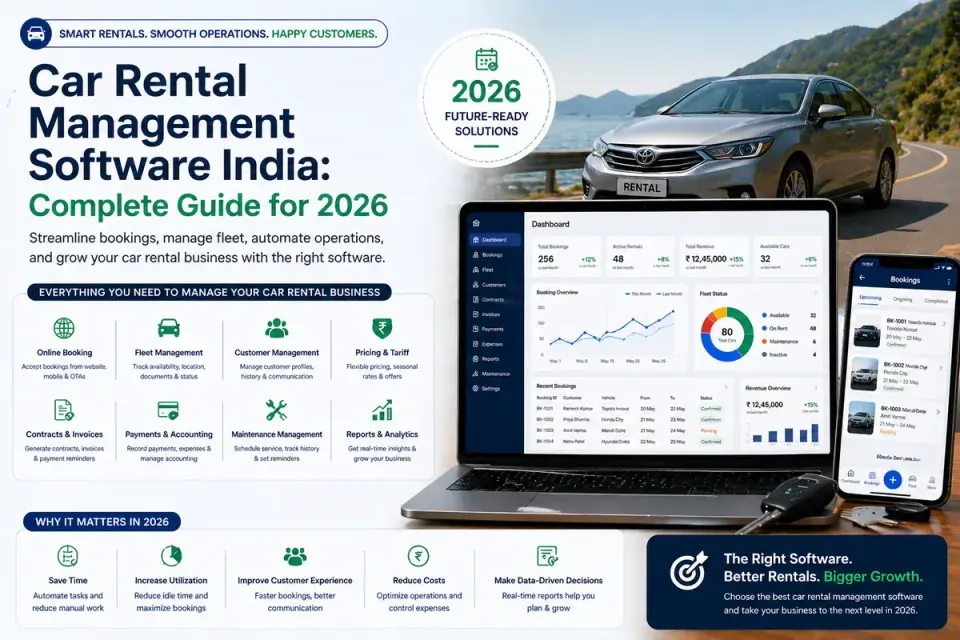
- Car Rental Management Software India: Complete Guide for 2026
- Best Fleet Management Software in India for Tour Operators (2026)
- Vehicle Tracking Software India: Complete Buyer's Guide
- How Vehicle Tracking Software Saves Indian Fleets Lakhs Per Year
Stop Leaving Money on the Table
The fastest way to quantify what billing automation will recover for your business is to audit your last month's invoices against your driver trip logs: compare invoiced distance vs. GPS distance, and check whether every trip that incurred waiting time or toll charges was billed for them. Most operators who do this audit find ₹50,000–₹2 lakh in recoverable revenue from a single month — before implementing any software at all. Once you have the number, the ROI calculation for billing software writes itself.
Track My Tour includes GPS-integrated, GST-compliant billing as a core feature — purpose-built for Indian car rental and tour operations. Book a free 30-minute demo and we'll show you the complete billing workflow with your rate structure and client mix.