For most Indian tour operators, booking management is the first thing that breaks as the business grows. At 5 vehicles, a shared WhatsApp group and a coordinator with a good memory keep operations running. At 20 vehicles with 3 coordinators handling bookings from corporate clients, travel agents, and direct inquiries simultaneously, you're statistically guaranteed to have at least one double-booking, one missed trip, or one billing error per week — and each one costs you more than a full month's software subscription. Booking management software for Indian tour operators exists to make these failures technically impossible, not just less likely.
This guide covers what booking management software actually solves for Indian ground transport businesses, the features to demand, the questions to ask in demos, and what to expect in terms of implementation and ROI.
What Is Booking Management Software for Tour Operators?
Booking management software is a centralised platform where every trip booking — regardless of how it arrives (phone call, WhatsApp, email, corporate portal, direct website) — is captured in a single queue, assigned to available vehicles and drivers, tracked in real time, and invoiced automatically at completion.
Quick Answer: Booking management software for Indian tour operators centralises every booking into one system, shows vehicle availability in real time across all coordinators simultaneously, prevents double-booking at the database level, auto-generates duty slips and GST invoices on trip completion, and provides a complete booking history for disputes and analytics. It replaces the combination of WhatsApp groups, shared spreadsheets, and phone coordination that creates booking chaos at scale.
The critical distinction from a generic CRM or booking platform: tour operator booking management must connect seamlessly to vehicle dispatch, driver scheduling, GPS tracking, and billing — because a "booking" in a tour operation isn't complete until the customer is delivered and the invoice is sent. A booking tool that stops at "booking confirmed" and requires a separate workflow for everything downstream is not a booking management solution — it's a booking record system.
5 Booking Problems Software Solves Permanently
Problem 1: Double-Booking the Same Vehicle
When two coordinators manage bookings separately — one handling corporate accounts, one handling retail inquiries — they can confirm the same vehicle for two different trips without either knowing. The discovery happens when a corporate client's vehicle doesn't arrive because it's already on another job. Booking management software maintains a single, real-time vehicle availability calendar that updates instantly across every coordinator's screen the moment a vehicle is assigned. Double-booking becomes a technical impossibility: the system rejects the second assignment automatically. No communication required between coordinators, no manual calendar checks, no morning reconciliation calls.
Problem 2: Missed Trips
Missed trips — where a booking exists but no vehicle or driver is ever assigned — happen because bookings arrive through different channels and get lost between receipt and action. A WhatsApp message from a travel agent that a coordinator reads and mentally notes "I'll assign this later" doesn't make it onto any calendar. Booking management software creates a single inbox where every booking waits for explicit action. Unassigned bookings remain visible and flagged in the system until a coordinator assigns a vehicle and driver — they cannot disappear into a notification history or get overlooked in a scroll.
Problem 3: Billing Errors and Revenue Leakage
When billing is done manually after trips — based on coordinator memory, WhatsApp records, and paper notes — errors accumulate in both directions: undercharging (not billing for waiting time, tolls, or night halts) and overcharging (billing for extras the client didn't actually receive). Booking management software captures every trip detail at the time of booking, logs actual trip parameters (GPS distance, waiting time, extras) from driver app data, and generates invoices from verified records rather than memory. Operators who switch from manual to software-based billing typically recover 8–15% in previously unbilled extras within the first month.
Problem 4: No Single Source of Booking History
When a corporate client disputes a charge from three months ago, finding the original booking confirmation, the duty slip, and the invoice in a mix of WhatsApp histories, email threads, and paper files is a multi-hour exercise — and the relevant records are often missing or incomplete. Booking management software maintains a permanent, searchable record of every booking: the original request, all changes, the assigned vehicle and driver, the GPS trip record, the duty slip, and the invoice. Resolving a client dispute takes two minutes instead of two hours, and the data is always complete.
Problem 5: No Real-Time Booking Status Visibility
When an operations director asks "how many trips do we have confirmed for next Saturday?" in a WhatsApp-based operation, getting the answer requires asking each coordinator to check their personal records and consolidate. In booking management software, that question is answered by a three-second dashboard query showing every booking, by date, status, vehicle, and driver — visible to everyone simultaneously without any consolidation required. This single capability transforms daily planning from a coordination exercise into a 15-minute data review.
Features to Demand in Booking Management Software
Multi-Channel Booking Capture
Bookings must flow into one system from all sources: direct phone entry by coordinators, WhatsApp forwarding, email-to-booking parsing, corporate portal submissions, and website contact form integration. The fewer manual steps between "booking request received" and "booking in the system," the less room for bookings to be lost.
Real-Time Availability Calendar
Vehicle and driver availability must be visible simultaneously to all coordinators, updating in real time without manual refresh. The calendar must show vehicle type, capacity, current location, and next maintenance date in a single view — giving coordinators complete information for assignment decisions without navigating multiple screens.
Automated Customer Communication
The moment a booking is confirmed, the customer should receive an automatic confirmation with trip details. When the vehicle departs, the customer should receive a live tracking link. When the trip ends, the customer should receive a completion notification and invoice. These communications should be triggered by trip events — not require coordinator action for each one.
Corporate Billing Workflows
Corporate clients typically require PO-based invoicing, monthly consolidated billing statements, and cost-centre allocation. Booking management software for Indian operators must handle both retail (per-trip) and corporate (PO-based, periodic) billing simultaneously — because most tour operators serve both types of clients from the same fleet.
Booking Modification Tracking
Trip changes — itinerary updates, timing changes, vehicle upgrades, passenger additions — must be tracked with a complete change history: who changed what, when, and why. This is essential for billing disputes (proving the client requested the additional stop), compliance (demonstrating the trip was executed as booked), and operations analysis (understanding why certain trips routinely change after confirmation).
What to Expect During Implementation
Implementing booking management software for a 20–40 vehicle operation typically takes 7–10 days:
- Day 1–2: Configure booking intake forms, vehicle types, pricing rules, and GST settings.
- Day 3–4: Train coordinators on booking entry, assignment, and status management (typically a 4-hour session).
- Day 5–7: Run parallel operations — all new bookings go through the software; validate output against existing workflow.
- Day 8–10: Full migration; retire the WhatsApp and spreadsheet system for new bookings.
The most common implementation challenge is coordinator adoption — not technical setup. Coordinators who have managed bookings their own way for years resist the constraint of a system. Frame the implementation as giving coordinators better information (real-time availability, booking history, status dashboards) rather than monitoring their individual performance. Adoption improves significantly when coordinators experience firsthand that the system prevents the double-booking that previously put them in difficult conversations with clients.
Frequently Asked Questions
What is booking management software for tour operators?
Booking management software for tour operators is a centralised platform that captures every trip booking (regardless of channel), shows real-time vehicle and driver availability to all coordinators simultaneously, prevents double-booking, generates confirmation communications automatically, tracks bookings through to GPS-verified trip completion, and auto-generates duty slips and GST invoices. It replaces the WhatsApp groups, shared spreadsheets, and phone-based coordination that create booking chaos when a tour operation scales past 10–15 vehicles.
How is booking management software different from a CRM?
A CRM (Customer Relationship Management system) manages customer data, sales pipelines, and client communication history. Booking management software manages operational workflows: trip scheduling, vehicle and driver assignment, real-time tracking, duty slip generation, and billing. For Indian tour operators, you need the operational layer — the booking-to-billing workflow — far more urgently than a sales CRM. The best tour operator platforms include both a booking management layer and basic client database functionality, so you don't need to pay for both separately.
Can booking management software work for small operators with 8–12 vehicles?
Yes, and the ROI is often faster at small scale because the owner-operator is typically the main coordinator — meaning every booking error has a direct personal cost in time and relationships. A small operator implementing booking management software typically recovers the subscription cost within 45–60 days through three sources: prevented double-booking recoveries (one avoided double-booking pays for 2–3 months of software), recovered unbilled extras, and time saved on manual coordination. Per-vehicle pricing means the software cost scales with fleet size — 10 vehicles pays significantly less per month than 50.
How does booking management software handle multiple coordinators?
Booking management software assigns role-based access to each coordinator: some coordinators may only create and view bookings, while senior coordinators or operations managers can also modify, delete, and generate reports. All coordinator actions are logged with timestamps — creating an accountability record without requiring micromanagement. The shared availability calendar means every coordinator operates from the same data simultaneously, eliminating the coordination overhead of distributed booking management.
Does booking management software integrate with WhatsApp?
The best Indian tour operator platforms include WhatsApp integration for sending automated booking confirmations, trip status updates, and customer tracking links. This means coordinators continue using WhatsApp for client communication, but the messages are triggered by system events — not manual coordinator action. Inbound WhatsApp booking requests can be converted to system bookings with a few clicks, eliminating the manual re-entry step that causes bookings to be lost or duplicated in WhatsApp-only workflows.
Further Reading
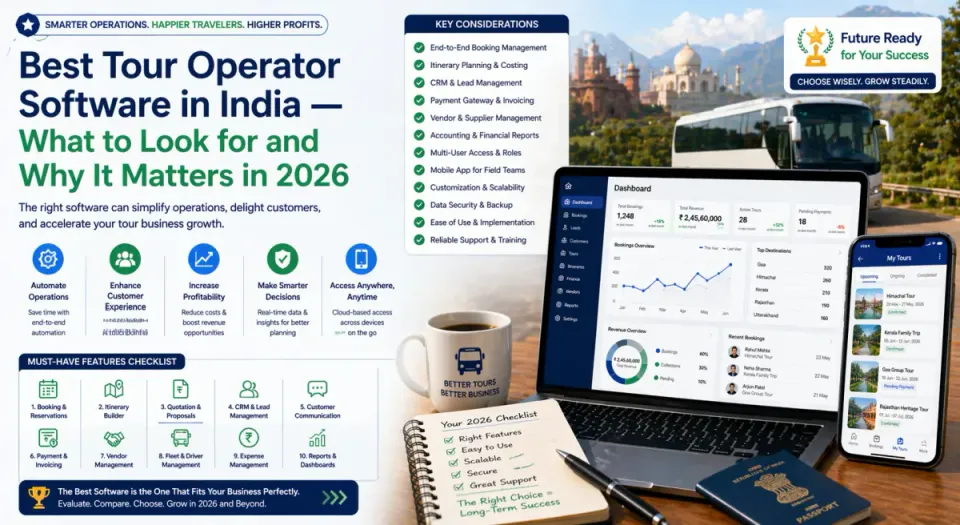
- Best Tour Operator Software in India — What to Look for in 2026
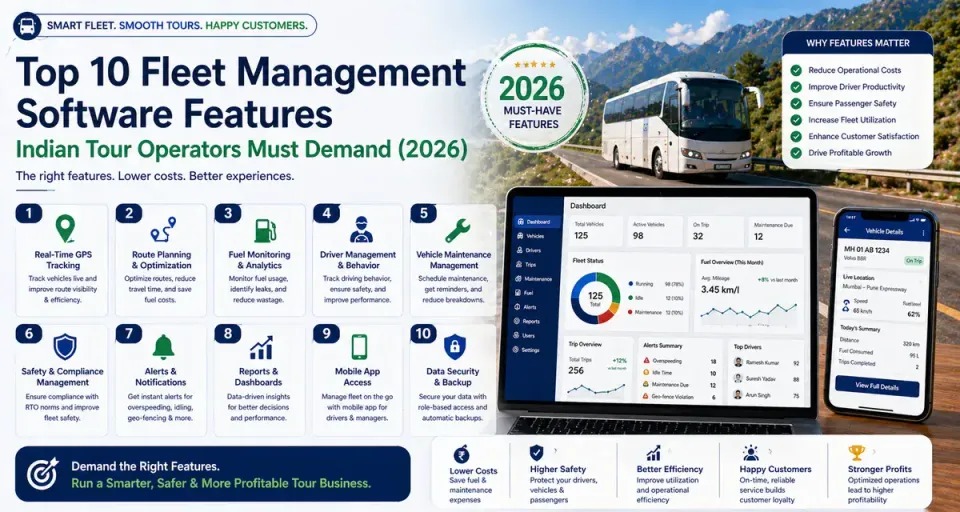
- Top 10 Fleet Management Software Features Indian Tour Operators Must Demand
- Best Fleet Management Software in India for Tour Operators (2026)
- Vehicle Document Management for Indian Fleets
Fix Your Booking Workflow This Week
The fastest way to validate whether a booking management platform will work for your operation is to test it with a real booking scenario — a multi-stop corporate trip with two vehicle types, a mid-day itinerary change, and an end-of-month consolidated invoice. That scenario exposes every weakness in the platform's booking-to-billing workflow.
Track My Tour's booking management module is built for Indian ground transport operators — from single coordinators managing 10 vehicles to enterprise operations with multiple branches. Book a free 30-minute demo and we'll show you the complete booking workflow with your fleet configuration.