For years, fleet technology was sold in pieces. One vendor handled GPS tracking. Another handled maintenance scheduling. A third handled driver compliance. Operators stitched these tools together with spreadsheets, WhatsApp groups, and a lot of manual follow-up.
That era is ending.
A recent partnership announcement between Linxup, a GPS fleet tracking provider, and Fleetio, a leading fleet maintenance platform, has put a spotlight on a trend that has been building for years: fleet operators are no longer satisfied with disconnected tools. They want a single, connected system that brings tracking, maintenance, inspections, and reporting together.
This shift isn't limited to the United States, where the announcement originated. It reflects a global pattern in fleet operations management, and it has direct implications for Indian fleet operators, tour operators, and employee transport providers managing fleets of every size.
In this article, we break down what was announced, why mid-market fleets are driving the shift toward integration, and what it means for businesses managing tour operations, corporate transport, and mobility services — including a closer look at why this trend matters specifically for fleet operators in India.
Quick Summary
- GPS tracking provider Linxup and maintenance platform Fleetio announced an integration connecting location data, maintenance, and inspections into one workflow
- Mid-market fleets (20–200 vehicles) are driving demand for integrated fleet management platforms instead of disconnected point tools
- Tour operators and employee transport providers face the same reliability, safety, and compliance challenges as logistics fleets
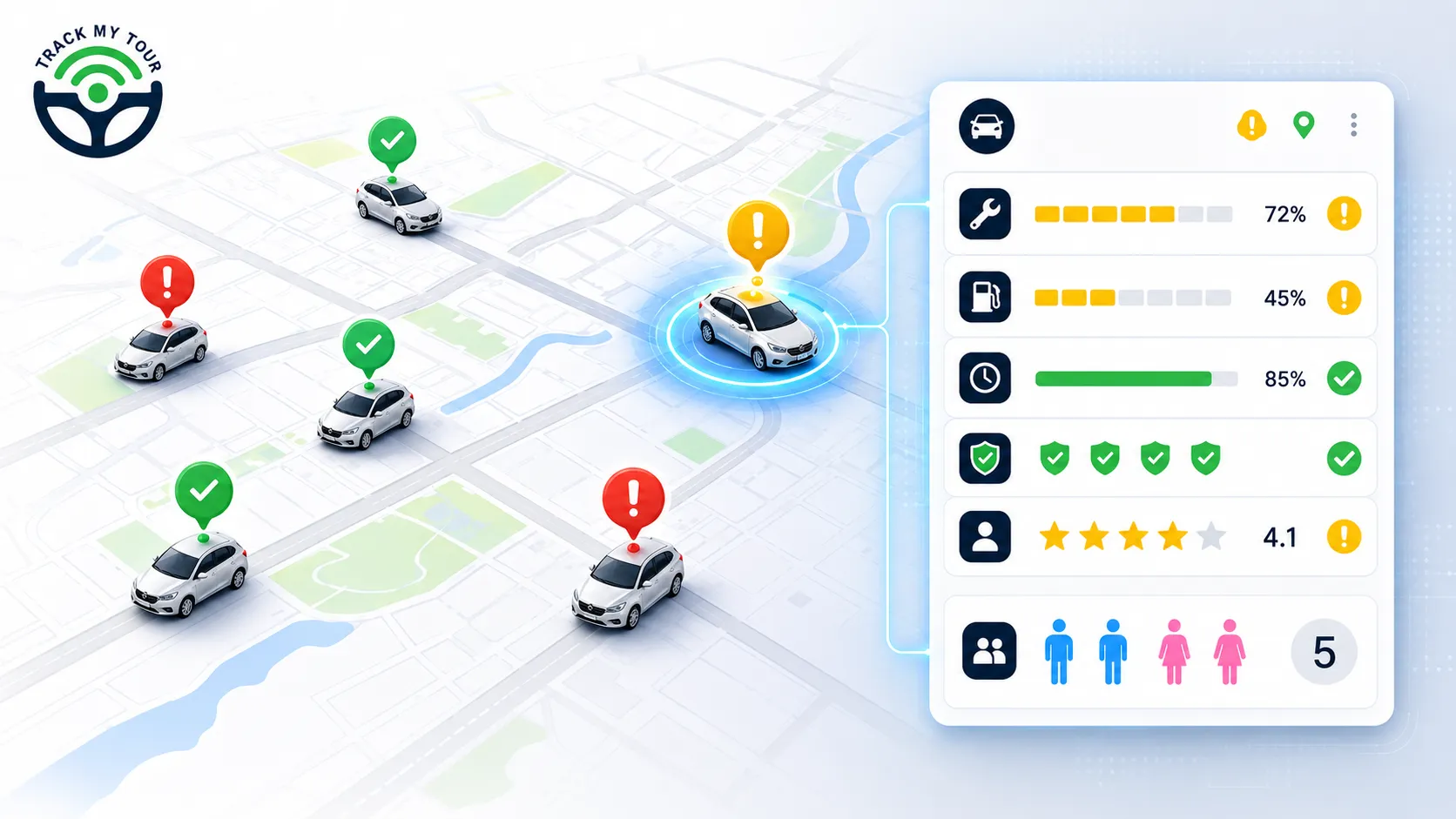
- A complete fleet platform today means GPS tracking, driver management, inspections, maintenance, and reporting working together — not five separate logins
- Indian operators face added complexity from interstate compliance and vendor vehicles, making integration even more valuable
Quick Answer: A recent partnership between GPS tracking provider Linxup and fleet maintenance platform Fleetio signals a global shift — fleet operators no longer want separate tools for tracking, maintenance, inspections, and reporting. They want one connected integrated fleet management platform. For businesses running 20 to 200 vehicles, including tour operators, employee transport providers, and mobility companies, disconnected systems create blind spots that cost time, money, and customer trust. Integration is becoming the new baseline, not a premium feature.
A New Benchmark for Fleet Technology
At first glance, the Linxup–Fleetio partnership might look like a routine product integration — the kind of announcement that gets a quick mention in an industry newsletter and is forgotten by the next quarter. But it actually reveals one of the most significant shifts happening in fleet management software today.
Linxup serves small and mid-sized businesses with GPS fleet tracking. Fleetio is known for its maintenance and inspection workflows. Together, the two platforms now allow vehicle location data, mileage readings, diagnostic information, inspection results, and maintenance workflows to operate as one connected system — instead of living in separate silos that someone has to manually reconcile.
For businesses managing fleets of 20 to 200 vehicles, this kind of integration is quickly becoming an expectation, not a competitive advantage. Operators in this size range are large enough to feel the pain of fragmented systems, but often too lean to staff a full IT team to manage the gaps between tools.
What Exactly Was Announced?
The partnership enables Linxup customers to automatically send vehicle data directly into Fleetio's maintenance platform. This includes:
- Vehicle location information
- Odometer readings
- Diagnostic trouble codes
- Vehicle inspection reports
- Maintenance records
Instead of a fleet manager manually updating maintenance schedules based on guesswork or outdated mileage logs, service reminders are now triggered automatically based on actual vehicle usage data.
For fleet managers, the practical impact is straightforward:
- Fewer spreadsheets to maintain
- Less manual administrative work
- Greater visibility into the real-time health of every vehicle
The announcement is a useful case study, but the underlying message is bigger than the two companies involved. Businesses no longer want a separate tool for every operational task. They want systems that talk to each other — and ideally, systems that were built to work together from day one.
Why Mid-Market Fleets Are Driving This Change
Historically, only large enterprises had access to sophisticated, fully integrated fleet management ecosystems — because only they had the budget and technical resources to deploy and maintain multiple connected solutions at once.
Mid-market operators, by contrast, often relied on a patchwork of:
- Basic GPS tracking systems
- Spreadsheets for maintenance logs
- Paper-based inspection reports
- Standalone maintenance software with no connection to tracking data
That patchwork approach is becoming increasingly difficult to sustain. As a fleet grows from 10 vehicles to 50, and from 50 to 150, operational complexity doesn't grow at the same steady pace — it compounds.
Fleet managers operating at this scale need fast, reliable answers to questions such as:
- Which vehicles require servicing right now?
- Are drivers actually completing their inspections, or just signing off on paper?
- Which assets are generating the highest maintenance costs?
- Are routes being operated as efficiently as they could be?
- Which vehicles present the greatest safety risk to the fleet?
When the information needed to answer these questions is scattered across multiple disconnected systems — a GPS dashboard here, a maintenance spreadsheet there, a stack of paper inspection forms in a drawer — finding the answer becomes time-consuming and, often, unreliable. By the time a fleet manager pieces together the full picture, the problem has frequently already become a breakdown, a missed inspection, or a compliance gap.
This is exactly why demand for integrated fleet management platforms is accelerating so quickly across the mid-market segment.
What This Means for Tour Operators and Employee Transport Providers
The significance of this trend extends well beyond logistics and delivery fleets — the use case most people associate with GPS tracking and maintenance software.
Tour operators, employee transport providers, corporate shuttle services, and broader mobility businesses face many of the same operational challenges as logistics fleets, often with even less room for error.
Consider the stakes involved:
- A vehicle breakdown on a tour route can result in missed pickups, frustrated travelers, and a damaged reputation that's hard to win back.
- In employee transport management, a delayed shuttle isn't just an inconvenience — it can mean employees arriving late to shifts, compliance issues with corporate transport SLAs, and real safety concerns if a vehicle is pressed into service without proper maintenance checks.
- For mobility businesses generally, vehicle reliability is directly and inseparably linked to service quality.
When GPS vehicle tracking, vehicle inspections, maintenance scheduling, and operational reporting are all connected within one system, businesses get a far clearer, real-time picture of fleet performance — instead of a delayed, fragmented one.
This connected visibility allows operators to:
- Reduce unexpected breakdowns before they disrupt a trip or shift
- Improve passenger safety through consistent, trackable inspections
- Increase vehicle availability by catching maintenance needs early
- Simplify compliance reporting for audits, contracts, and internal review
- Improve overall operational efficiency across every route and shift
For companies managing dozens of vehicles across multiple routes — whether that's a tour operator running multi-day itineraries or an employee transport provider managing dozens of corporate shuttle routes — these improvements aren't marginal. They have a measurable business impact on cost, safety, and customer retention.
The New Definition of a Complete Fleet Platform
The Linxup–Fleetio announcement also reveals something important about how customer expectations have changed.
A few years ago, GPS tracking alone was considered a genuinely valuable fleet management solution on its own. Simply knowing where a vehicle was at any given moment felt like a meaningful upgrade over no tracking at all.
Today, customers expect significantly more. A modern fleet platform is now expected to include:
- Real-time GPS fleet tracking
- Driver management
- Vehicle inspections
- Preventive vehicle maintenance scheduling
- Route monitoring
- Operational reporting
- Analytics and dashboards
Most importantly, customers want all of these capabilities to live within one connected ecosystem — not as five separate logins, five separate data sets, and five separate support teams to coordinate between.
The era of switching between five different software tools just to answer one operational question is gradually coming to an end. Operators are increasingly evaluating fleet platforms based on how well they integrate operational workflows — not simply on how many individual features appear on a sales sheet.
What This Means for the Future of Fleet Management
As fleet technology continues to evolve, integration is set to become one of the most important competitive factors in the entire fleet software market.
Businesses across every sector are under sustained pressure to reduce costs, improve safety, and increase operational visibility — often simultaneously, and often with leaner teams than they had a few years ago.
Disconnected systems make all three of these goals significantly harder to achieve. Every gap between systems is a place where information gets lost, delayed, or simply never reconciled.
Integrated platforms, by contrast, allow teams to move faster, make better-informed decisions, and respond more effectively when operational challenges arise — because the relevant data is already in one place, not scattered across five logins.
The winners in the next phase of fleet technology will not necessarily be the companies offering the most individual features. They will be the companies that build the most connected, most efficient operational experience for the people actually running fleets day to day.
Why This Matters for Indian Fleet Operators
While the Linxup–Fleetio partnership is a US-based announcement, the underlying trend is directly relevant to fleet operators in India — arguably even more so, given the operational realities many Indian businesses face.
Indian tour operators, employee transport providers, and mobility companies frequently manage fleets that include a mix of owned vehicles and vendor-supplied vehicles, operate across multiple states with varying compliance requirements, and run on tighter operational margins than equivalent businesses in more mature markets. In this environment, fragmented systems aren't just inconvenient — they're a direct source of avoidable cost and risk.
A few reasons this trend carries particular weight in India:
- Compliance complexity is higher: Vehicle documents, permits, and driver credentials must be tracked across states with different rules, making disconnected manual tracking especially error-prone.
- Vendor vehicles are common: Many fleets blend owned and third-party vehicles, which makes a single source of truth for tracking and maintenance even more valuable.
- Margins are tighter: Unplanned breakdowns or compliance penalties have an outsized impact on profitability for mid-market Indian operators compared to larger, better-capitalized fleets.
- Customer expectations are rising: Corporate clients booking employee transport, and travelers booking tours, increasingly expect real-time visibility and reliable service — something fragmented systems struggle to deliver consistently.
For Indian fleet and tour operators evaluating new technology, the lesson from the Linxup–Fleetio partnership is clear: the question to ask a vendor is no longer just "Does this track my vehicles?" It's "Does this connect tracking, maintenance, driver management, and reporting into one system I can actually run my business from?"
Key Takeaways
- The Linxup–Fleetio partnership highlights growing demand for integrated fleet platforms.
- Mid-market operators are leading the shift away from disconnected software tools.
- GPS tracking and maintenance management are becoming closely connected operational functions.
- Tour operators and employee transport providers face many of the same integration challenges as logistics fleets.
- Future fleet management platforms will be judged by how well they connect operations, maintenance, and visibility into a single experience.
- Indian operators face additional compliance and vendor-management complexity that makes integration even more valuable.
The Track My Tour Perspective
For Track My Tour customers, this industry trend reinforces a simple reality: operational visibility matters more than ever.
Tour operators, employee transport providers, and corporate mobility teams need more than GPS tracking alone — they need a connected operational platform that helps manage trips, vehicles, drivers, compliance, and overall business performance from a single system, rather than juggling multiple disconnected tools.
The growing demand for integrated solutions shows that fleet operators everywhere, including in India, are moving away from fragmented workflows and toward unified operations. The question is no longer whether integration matters. The question is how quickly a business can adopt it to improve reliability, efficiency, and customer experience.
Frequently Asked Questions
What is an integrated fleet management platform?
An integrated fleet management platform combines GPS tracking, vehicle maintenance, driver management, inspections, and reporting into a single connected system — instead of requiring separate tools that don't share data with each other.
Why are mid-market fleets driving demand for integration?
Mid-market operators (typically 20–200 vehicles) are large enough to feel the operational pain of disconnected systems but often don't have the resources to build custom integrations themselves, making an out-of-the-box integrated platform especially valuable.
Does this trend apply to tour operators and employee transport providers, or just logistics fleets?
It applies broadly. Tour operators and employee transport providers face the same core challenges — vehicle reliability, safety, compliance, and operational visibility — that make integrated platforms valuable for any fleet-dependent business.
What should Indian fleet operators look for when evaluating fleet software?
Beyond GPS tracking alone, Indian operators should look for platforms that also handle maintenance scheduling, driver and document compliance, vendor vehicle management, and reporting — all within one connected system suited to multi-state operations. Track My Tour is built around this kind of connected operational workflow for Indian fleet and tour operators.
Is GPS tracking alone still enough for modern fleet management?
No. While GPS tracking remains foundational, today's fleet operators expect it to be paired with maintenance, inspections, driver management, and reporting in a single platform rather than treated as a standalone tool.
Further Reading
- Best Fleet Management Software in India for Tour Operators (2026)
- Fleet Automation Software: How It Saves 10–15 Hours a Week
- Employee Transport System India — A Complete Guide
- Driver Management Software India — What to Look For
- Vehicle Tracking Software India — Buyer's Guide
Bring Tracking, Maintenance, and Compliance Into One System
If your fleet operations are still split across GPS tracking, maintenance spreadsheets, and paper-based inspection reports, the gap between your business and an integrated, connected fleet platform is only going to get more costly to maintain.
See how Track My Tour brings GPS tracking, vehicle maintenance, driver management, and compliance reporting together in one connected platform built for Indian fleet and tour operators.
Book a free demo and see how it works for your fleet.