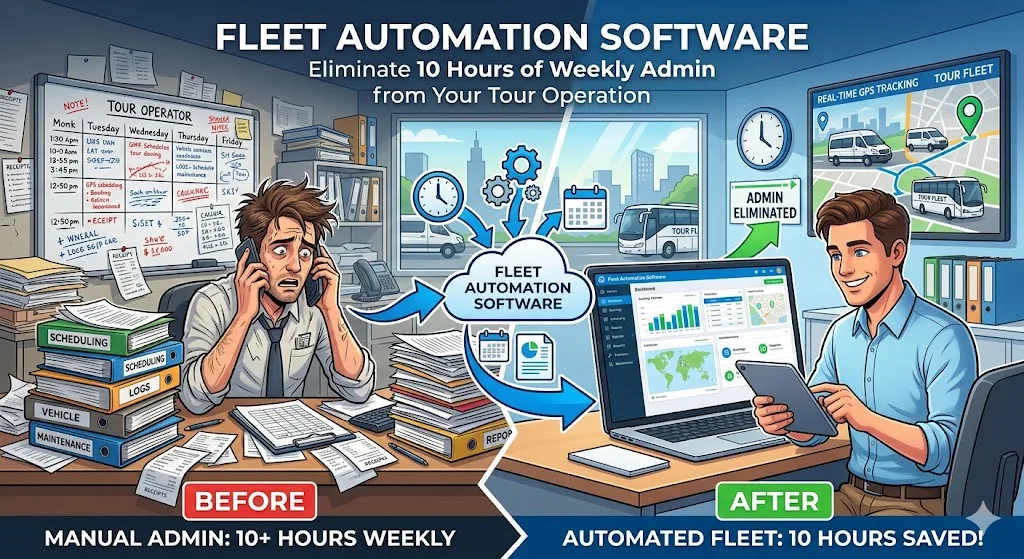
Most Indian tour operators are running a 2026 fleet operation on a 2010 workflow. Vehicles are assigned by phone call. Duty slips are typed on Word or filled by hand. Fuel expense claims are tallied on paper and handed to accounts at month-end. Vehicle document expiry is tracked on a shared Google Sheet that's three weeks out of date. The result: your most experienced coordinator spends 10–15 hours per week doing work that fleet automation software could do in seconds — leaving less time for the operational decisions that actually require human judgement.
Automation in fleet management isn't about replacing people. It's about eliminating the mechanical, repetitive, error-prone tasks from their workload so they can focus on what matters: customer escalations, driver performance, and strategic planning. This guide covers the 8 highest-impact workflows to automate first, and what to look for in fleet automation software built for Indian tour operations.
What Is Fleet Automation Software?
Fleet automation software is a platform that executes rule-based fleet operations workflows automatically — without coordinator intervention — whenever predefined conditions are met. Instead of a coordinator manually creating a duty slip after every trip, the software generates it the moment a trip is marked complete. Instead of someone setting a calendar reminder for insurance renewals, the software sends an alert 30 days before every document expiry, every time, for every vehicle.
Quick Answer: Fleet automation software removes the manual steps from repetitive fleet workflows — duty slip generation, document expiry alerts, driver assignment notifications, fuel expense cross-referencing, billing generation, and maintenance reminders. For Indian tour operators, the combined time saving across all automated workflows typically adds up to 10–15 hours of coordinator time per week per 25-vehicle fleet.
The key distinction between basic fleet management software and fleet automation software is the degree to which the platform acts without prompting. Basic software stores data and lets you run reports. Automation software triggers actions — notifications, document generation, alerts, status updates — based on trip events, calendar triggers, and data thresholds. The more triggers it handles automatically, the less your team has to remember to do manually.
8 Fleet Workflows Worth Automating First
1. Duty Slip Generation
Generating duty slips manually for every trip is the highest-volume repetitive task in most Indian tour operations. A 30-vehicle fleet running 2–3 trips per vehicle per day produces 60–90 duty slips daily. At even 3 minutes per slip, that's 3–4.5 hours of admin time daily — entirely eliminatable. Fleet automation software generates duty slips automatically the moment a trip is logged in the system, pre-populated with vehicle registration, driver name, pickup and drop locations, trip date, start and end times, and GPS-recorded distance. Operators who automate duty slip generation report saving 8–12 hours of weekly admin time immediately.
2. Vehicle Document Expiry Alerts
Manually tracking 8–10 documents across a 30-vehicle fleet (insurance, fitness certificate, pollution certificate, permit, road tax, driver licence, passenger badge) means tracking 240–300 renewal dates simultaneously. A single miss results in a fine or, worse, vehicle detention. Automated document management sends alerts to the operations manager 30 days before every expiry, repeats at 15 days, and flags the vehicle as non-deployable if an expired document isn't renewed and updated in the system. No reminders to remember, no calendar entries to maintain — the system handles it permanently. See: Vehicle Document Management for Indian Fleets.
3. Driver Trip Notifications and Confirmations
In a manual workflow, assigning a driver to a trip requires a phone call, a WhatsApp message, and a follow-up to confirm they received it. Multiply this by 30–50 trips per day, and a coordinator's morning is consumed by confirmation chasing. Fleet automation software sends push notifications to the driver app the moment a trip is assigned, logs acknowledgement in the system, and escalates to the coordinator automatically if the driver hasn't confirmed within a set time window. The confirmation chain is managed by the software — coordinators only intervene for exceptions.
4. Fuel Expense Cross-Referencing
When a driver submits a fuel expense claim, fleet automation software immediately cross-references the claimed fill-up amount against the GPS-recorded trip distance for the same period, the vehicle's certified fuel efficiency, and previous fill-up timestamps. If the numbers don't align within a configurable tolerance, the claim is flagged for coordinator review automatically — without the coordinator needing to remember to check. This transforms fuel leakage detection from a monthly reconciliation exercise into a real-time control system. See: How Vehicle Tracking Software Saves Indian Fleets Lakhs Per Year.
5. GST Invoice Generation
Every completed trip should automatically trigger a draft GST invoice with vehicle details, driver details, trip distance (GPS-verified), applicable GST rate, and invoice number. For regular corporate clients, the system should batch invoices by billing period and send them automatically. Manual invoice creation introduces errors, delays payment, and creates reconciliation headaches for your accounts team. Automating this step alone is worth ₹1–₹3 lakh per year in recovered cash flow for operators currently running 10–30 day billing cycles — simply by compressing invoice delivery to same-day.
6. Maintenance Reminders
Preventive maintenance scheduled by the calendar (e.g., every 5,000 km or every 3 months) prevents the expensive breakdown that grounds a vehicle mid-trip. Fleet automation software tracks odometer readings from GPS data, calculates distance since last service, and triggers a maintenance alert when the vehicle approaches its service threshold — giving your workshop team a 200–300 km warning rather than a surprise breakdown call. Proactive maintenance reduces unplanned repair costs by 25–35% compared to reactive repairs.
7. Customer Trip Status Notifications
When a vehicle departs for a pickup, fleet automation software can automatically send the passenger a "your vehicle is on the way" message with a live tracking link — without any coordinator action. When the driver marks the trip started, the customer gets notified. When the trip ends, the customer receives a completion summary. This automation reduces customer service calls by 40–60% and raises satisfaction scores without adding to coordinator workload. It's the most visible customer-facing automation, and one that customers immediately appreciate.
8. Daily Operations Reports
At the end of each day, fleet automation software can automatically compile and send a summary report to operations managers: trips completed, trips pending, vehicles not utilised, fuel consumed, expenses logged, document alerts active, and driver no-shows. This replaces the end-of-day coordinator debrief call and gives managers the information they need to plan the next day without manual data collection. A daily automated summary for a 30-vehicle fleet takes 30 seconds to read — replacing 20–30 minutes of data gathering from multiple sources.
The Business Case for Fleet Automation in India
The ROI calculation for fleet automation software in India is straightforward for mid-sized operators:
- Coordinator time saved: 10 hours/week × ₹250/hour effective cost = ₹2,500/week = ₹1.3 lakh/year
- Fuel leakage reduced: 15% of ₹3 lakh/month fuel spend = ₹45,000/month = ₹5.4 lakh/year
- Document fine prevention: 2–3 prevented fines/year at ₹5,000–₹10,000 each = ₹15,000–₹30,000/year
- Faster invoicing: Compressing 15-day billing cycle to 2 days on ₹15 lakh monthly invoicing improves working capital by ₹1.95 lakh
Combined, the financial benefit of comprehensive fleet automation for a 30-vehicle Indian tour operator typically exceeds ₹8–₹10 lakh annually — against a software cost of ₹2–₹3 lakh per year.
What to Look for in Fleet Automation Software for India
Not every "fleet management software" includes genuine automation. When evaluating platforms, ask specifically:
- Does duty slip generation happen automatically on trip completion, or does someone need to trigger it?
- Are document expiry alerts proactive (software alerts you) or reactive (you run a report to check)?
- Does the driver notification system have mandatory acknowledgement and automatic escalation?
- Is fuel cross-referencing automated or a manual report you need to remember to run?
- Does invoice generation require manual input, or does it pull from trip data automatically?
If the answer to most of these is "you need to run a report" or "the coordinator triggers it," the software stores data but doesn't automate — which is significantly less valuable. True automation means the system acts, not the coordinator.
Frequently Asked Questions
What is fleet automation software?
Fleet automation software is a fleet management platform that executes repetitive operational tasks automatically — without coordinator intervention — based on predefined triggers. Examples include: generating duty slips when trips are marked complete, sending document expiry alerts 30 days before renewal deadlines, notifying drivers of new trip assignments, cross-referencing fuel claims against GPS mileage, and generating GST invoices at trip completion. For Indian tour operators, automating these workflows typically saves 10–15 coordinator hours per week and significantly reduces error rates.
What is the difference between fleet management software and fleet automation software?
All fleet automation software is fleet management software, but not all fleet management software is automation software. Basic fleet management tools store vehicle data, trip records, and driver information — but require coordinators to manually run reports, generate documents, and trigger notifications. Fleet automation software goes further: it initiates actions automatically based on events (trip completed → duty slip generated), thresholds (document expires in 30 days → alert sent), or schedules (vehicle reaches 5,000 km → maintenance reminder triggered). The distinction is between a tool that helps you work and a system that works while you're not watching.
Can fleet automation software work for small operators with 10–15 vehicles?
Yes, and the benefits are proportionally significant at small scale. A 10-vehicle operation where the owner is also the operations coordinator benefits enormously from automated duty slips, document alerts, and driver notifications — because there's no separate coordinator to absorb the manual tasks. Automation is often more valuable for small operators than for large ones, because small operators have no administrative staff to delegate repetitive tasks to. Cloud-based platforms with per-vehicle pricing make the cost appropriate for fleet sizes from 5 vehicles upward.
How long does it take to implement fleet automation software?
Implementing fleet automation software for a 20–50 vehicle operation typically takes 5–10 business days: vehicle and driver data import, configuring automation rules (document alert thresholds, maintenance service intervals, billing triggers), driver app installation, and coordinator training. The automation rules themselves take 1–2 hours to configure and run permanently from that point — no ongoing maintenance required.
Is fleet automation software designed specifically for Indian compliance requirements?
International fleet automation platforms often lack India-specific features: GST invoice generation (with correct transport-sector rates), Indian vehicle document types (fitness certificate, tourist permit, PUC), INR currency throughout, and integration with Indian map data. When evaluating platforms, verify explicitly that GST invoicing, Indian document management, and Indian GPS coverage are native features — not add-ons or manual workarounds. Platforms built for Indian tour operators include these by design.
Further Reading
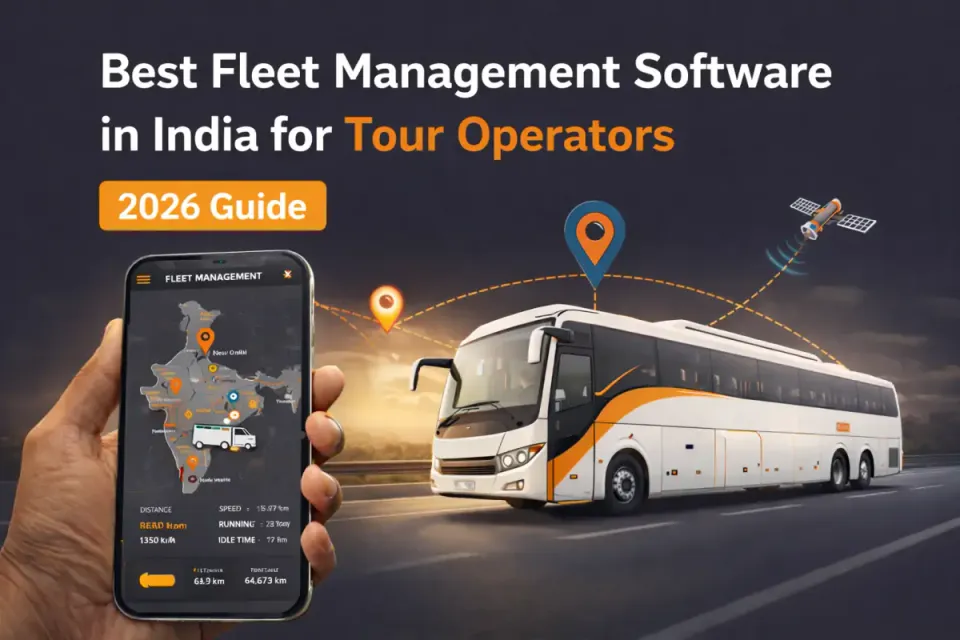
- Best Fleet Management Software in India for Tour Operators (2026)
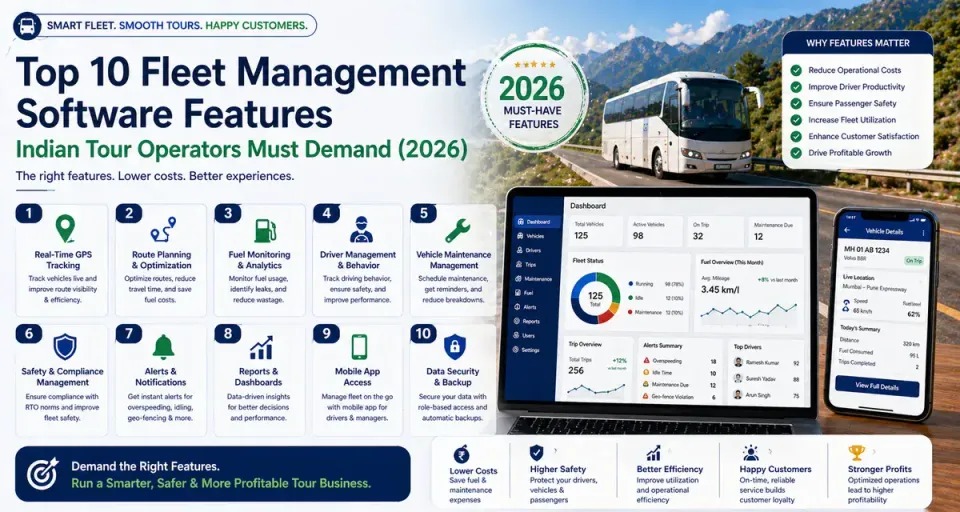
- Top Fleet Management Software Features Indian Operators Must Demand
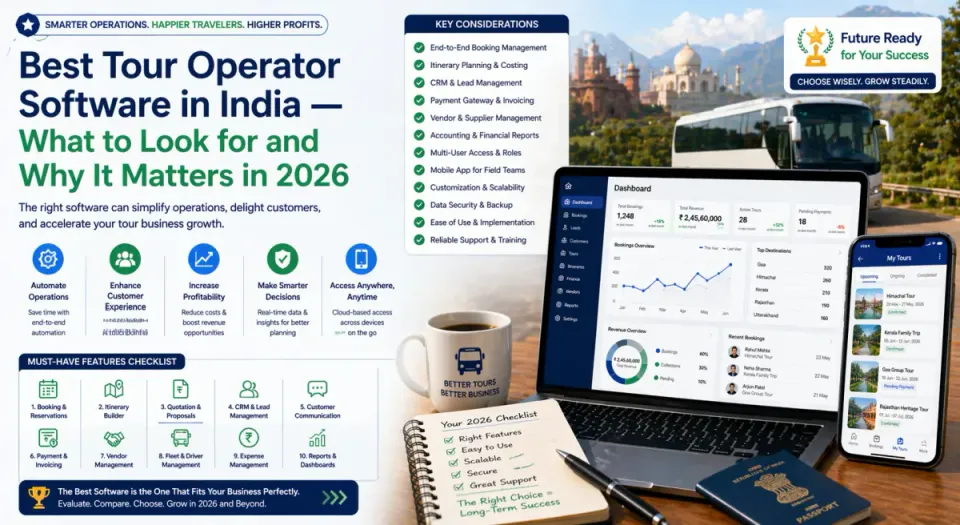
- Best Tour Operator Software in India — What to Look for in 2026
- How Vehicle Tracking Software Saves Indian Fleets Lakhs Per Year
Automate Your Fleet Operations — Starting This Week
The fastest way to validate whether fleet automation software will work for your operation is a demo built around your specific workflows. Ask the vendor to automate one specific task during the demo — duty slip generation, for example — and observe how many manual steps are actually eliminated versus how many still require coordinator action.
Track My Tour automates the full fleet operations workflow for Indian tour operators — from booking to billing, driver to duty slip, document to compliance alert. Book a free 30-minute demo and we'll map our automation features to your current manual workflows.